

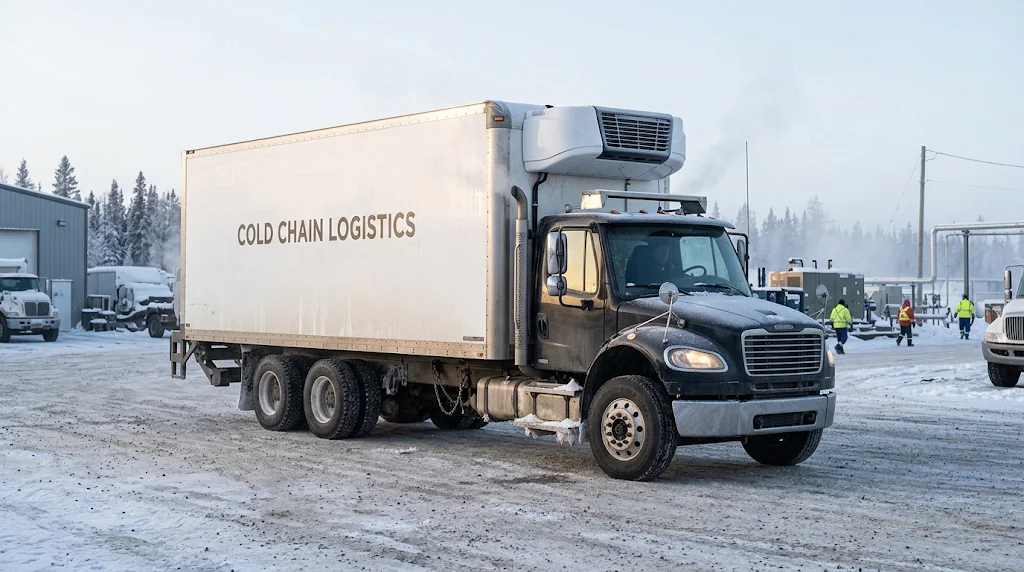
Executive Engineering Paradigm: The Shift in Transport Refrigeration Units for Sub-Zero Corridors
Cold chain logistics operations across Northern Canadian resource corridors, remote Indigenous health networks, and Arctic industrial staging routes confront a severe thermodynamic paradox. Conventional commercial transport refrigeration units (TRUs) are engineered primarily to reject thermal energy in temperate or high-ambient summer conditions ranging from to 1. When heavy commercial fleets operate across winter ice roads and remote northern highways where ambient temperatures routinely drop to , the operational mandate of transport refrigeration units inverts completely2. Rather than solely extracting heat from the cargo envelope, the mobile environmental control system must prevent catastrophic sub-zero thermal ingress that would freeze and denature temperature-sensitive pharmaceutical payloads ( to ) or chilled perishable commodities, while simultaneously maintaining deep-frozen compartments () across multi-temperature bulkheads1.
Historically, heavy-duty rigid trucks and articulated semi-trailers relied on standalone, two-engine architecture: the primary chassis propulsion engine and an auxiliary small-displacement diesel engine mounted within the nose-mount TRU housing6. Under extreme sub-zero operating profiles, auxiliary diesel transport refrigeration units exhibit elevated mechanical failure rates. Small-bore auxiliary diesel engines lack the thermal mass and heavy-duty block-heating infrastructure of a Class 8 propulsion powertrain, subjecting the secondary engine to rapid fuel waxing, paraffination of ultra-low-sulfur diesel (ULSD), crankcase oil gelation, glow-plug burnout, and starter battery depletion at . Furthermore, auxiliary TRU engines are governed by less stringent off-road emissions standards than the host vehicle’s primary engine, generating disproportionate particulate matter (PM), nitrogen oxides (), and carbon dioxide () while consuming up to of diesel fuel6.
To eliminate the reliability vulnerabilities and operating costs of secondary combustion engines, industrial cold chain engineering has shifted decisively toward non-diesel, hydraulic-driven Power Take-Off (PTO) transport refrigeration units2. Pioneered by Swedish and British hydraulic refrigeration specialists such as Hultsteins—which has developed hydraulic transport refrigeration units since 1962—and engineered for extreme North American mobile industrial and sub-zero climate duty by Polar Mobility Research Ltd. since 1981, hydraulic-driven architectures extract mechanical work directly from the host vehicle’s primary engine via a transmission- or engine-mounted PTO2. These systems encompass direct-hydrostatic Polar Transport Refrigeration (PTR) split systems, Hultsteins Ecofridge hydraulic single- and multi-temperature units for rigid chassis, and Hultsteins Ecogen and Ecogen2 PTO-driven hydraulic generators6. By consolidating power generation into a single, thermally stabilized Euro 6 or EPA-compliant heavy-duty engine block, fleets eliminate secondary diesel fuel systems, reduce TRU fuel consumption by up to (down to ), cut auxiliary exhaust emissions by more than , and achieve continuous, load-independent refrigeration and heating capacity from curb idle to highway cruise speeds6.
Hydraulic vs. Diesel Thermodynamics and Powertrain Engineering
Mechanical Breakdown of Hydraulic-Driven PTR Architecture vs. Auxiliary Diesel TRUs
A traditional auxiliary diesel TRU operates as an isolated electromechanical island mounted on the frontal bulkhead of a truck body or trailer. Its mechanical assembly houses an independent internal combustion engine, a dedicated fuel draw-line and filtration circuit, an auxiliary cooling radiator, a dedicated 12VDC starter motor and charging alternator, and a belt- or clutch-driven reciprocating or scroll refrigeration compressor. Every subsystem in this secondary powertrain duplicates components already operating on the host truck chassis, doubling preventative maintenance intervals, increasing vehicle tare weight on the steer axle, and introducing severe cold-start failure points in Arctic staging yards2.
Hydraulic-driven transport refrigeration units eliminate the auxiliary combustion engine entirely, replacing it with a closed-loop or open-loop hydrostatic power transmission circuit coupled directly to the vehicle’s primary powertrain6. In commercial heavy-fleet engineering, two primary mechanical topologies govern hydraulic TRU integration: direct-drive hydrostatic compressor systems and PTO-driven hydraulic generator hybrid systems6.
In the direct-drive hydrostatic compressor topology—exemplified by Polar Mobility’s hydraulic drive systems and Hultsteins’ Ecofridge architecture—a variable-displacement, load-sensing axial piston hydraulic pump is flange-mounted directly to the vehicle transmission’s Power Take-Off aperture10. Pressurized hydraulic fluid is routed through insulated high-pressure hoses along the chassis frame rail to the nose-mount or undermount TRU condensing unit12. Inside the condensing housing, the pressurized oil drives a hydraulic motor coupled directly to the refrigeration compressor shaft—such as a heavy-duty QPS 65 swash-plate compressor, a GY27 compressor, or a semi-hermetic reciprocating compressor—alongside the condenser fan assembly14.
In the PTO-driven hydraulic generator hybrid topology—exemplified by the Hultsteins Ecogen and Ecogen2 platforms as well as Polar Mobility’s PTR electric-standby split systems (K-FR500ES, K-FR800ES, K-MK358ES, and K-T355ES-GY27)—the transmission PTO drives a variable-displacement hydraulic pump that powers a chassis-mounted hydraulic generator6. This generator produces regulated, constant-frequency three-phase or single-phase alternating current ( or ) while the vehicle is in transit6. Conventional diesel transport refrigeration units are universally manufactured with built-in electric standby motors intended for depot shore-power plug-in6. By feeding PTO-generated electrical power directly into the TRU’s electric standby circuit on the road, an Ecogen retrofit transforms a legacy diesel TRU into an engineless electric hybrid during transit, or powers an all-electric engineless unit (such as a Polar PTR split system or Carrier Transicold Vector 8200 all-electric trailer unit) directly off the host truck’s primary engine6. In both hydraulic topologies, mechanical energy originates from the truck’s main diesel engine, which is already fortified with heavy-duty Arctic winterization infrastructure—including Eberspächer or ProHeat Dometic fuel-fired hydronic coolant heaters, sump heaters, and high-capacity thermal management—ensuring immediate, fail-safe operation at 12.
Thermodynamic Heat Transfer Capacity and Parasitic Load Calculations at -40°C
Sizing transport refrigeration units for extreme Northern Canadian corridors requires rigorous calculation of bidirectional conductive, convective, and infiltration heat loads across the insulated vehicle envelope. Under the international ATP (Agreement on the International Carriage of Perishable Foodstuffs) thermodynamic framework, the steady-state conductive heat transfer rate (, measured in Watts) penetrating through the walls, roof, and floor of an insulated transport body is governed by the fundamental isothermal heat balance equation1:
In this governing equation, represents the overall isothermal heat transfer coefficient (or U-value) of the insulated body expressed in or 1. The variable denotes the geometric mean surface area of the cargo body in , which is calculated from the total interior surface area () and total exterior surface area () of all six body walls according to the relation 1. The term defines the absolute temperature differential in Kelvin or degrees Celsius between the internal conditioned cargo space () and the external ambient environment ()1.
Under statutory ATP certification protocols, the nominal net refrigerating or heating capacity () of the transport refrigeration unit must exceed the steady-state conductive heat flux multiplied by a minimum safety coefficient of to compensate for solar radiation, air infiltration, and evaporator coil frost accumulation1:
However, in heavy commercial fleet engineering, sizing a unit solely to the statutory ATP baseline results in inadequate thermal recovery when insulation foam experiences long-term moisture ingress and thermal aging over multi-year Arctic duty cycles1. Consequently, industrial unit selection methodologies apply an operational safety coefficient () of instead of for chilled applications maintained at to , and an operational safety coefficient of instead of for deep-frozen applications maintained at 1. Furthermore, where delivery routes involve frequent multi-drop cargo access, engineering guidelines mandate increasing the unit’s net thermal capacity by an additional for every ten door openings beyond baseline assumptions1.
To illustrate the bidirectional thermodynamic demand on a heavy-duty rigid refrigerated truck, consider a cargo body with an internal volume of (typical for a three-axle rigid chassis rated for to at ambient), having external dimensions of and a geometric mean surface area of 1. The body walls are constructed with foamed-in-place polyurethane insulation at a core density of and a material thermal conductivity () of , yielding a certified ATP Class C overall body isothermal factor of 1.
During a summer high-ambient deep-frozen pull-down profile where external ambient air is and the internal frozen cargo setpoint is , the thermal gradient across the polyurethane walls is 1. Applying the fundamental heat balance equation alongside both the statutory ATP coefficient and the commercial operational safety factor yields the required cooling capacities1:
When the same vehicle is dispatched into an extreme Northern Canadian winter corridor at carrying freeze-sensitive medical supplies and vaccines maintained at a midpoint target of (within the statutory to envelope), the direction of heat flux reverses completely1. Thermal energy conducts rapidly outward from the cargo compartment into the atmosphere across a temperature differential of 1. Applying the chilled-cargo commercial safety coefficient—which compensates for severe convective wind-chill stripping at highway speeds, perimeter seal losses, and door-opening thermal drops—establishes the continuous heating capacity required from the PTR unit1:
Quantifying the parasitic mechanical load that this thermal duty imposes on the host vehicle’s main engine block requires coupling the thermodynamic demand to the hydrostatic fluid power equation. The mechanical shaft power (, in ) extracted from the transmission PTO aperture is governed by the volumetric flow rate of the hydraulic fluid (, in ), the hydraulic system working pressure differential (, in ), the overall hydromechanical and volumetric efficiency of the axial piston pump (, typically ), and the mechanical gear-mesh efficiency of the PTO assembly (, typically )15:
For a heavy-duty hydraulic PTR system delivering of fluid power to the refrigeration compressor motor or hydraulic generator at a regulated working pressure of and a load-sensed flow rate of , the parasitic shaft load drawn from the primary truck engine is16:
On a Class 8 heavy-duty diesel propulsion engine rated at (), a parasitic PTO draw of represents just of available crankshaft output. Given a modern heavy-duty Euro 6 or EPA-compliant engine brake-specific fuel consumption () of and an Arctic diesel fuel density of , generating at peak full-displacement output consumes , while modulated steady-state transit operation averages exactly —a reduction compared to the burned by an inefficient, small-displacement auxiliary diesel TRU engine6. Crucially, in Arctic operations, imposing a continuous parasitic load on the main propulsion block provides a vital secondary thermodynamic benefit: when the vehicle is idling at ice-road staging checkpoints or descending grades, the PTO load prevents main-engine cylinder cooling (“wet stacking”), maintains exhaust gas temperatures within the active threshold required for Selective Catalytic Reduction (SCR) and Diesel Particulate Filter (DPF) emission controls, and ensures an abundant supply of jacket coolant for the cargo box glycol heating exchangers6.
Refrigerant Phase-Change Dynamics and Compressor Efficiency Limits in Sub-Zero Profiles
Vapor-compression transport refrigeration units rely on the phase change of hydrofluorocarbon (HFC) or hydrofluoroolefin (HFO) refrigerants—principally R-404A (deployed across Polar Mobility’s PTR K-T355ES and K-T355ES-GY27 series) or lower-GWP R-452A formulations—circulating through three primary heat-transfer and compression stages17. In standard cooling mode, low-pressure liquid refrigerant enters the tube-and-fin evaporator coil inside the cargo compartment, absorbs heat from the internal air stream, and vaporizes into a low-pressure gas17. The compressor draws in this suction vapor and compresses it into a high-pressure, high-temperature superheated gas, which then passes through the external tube-and-fin condenser coil where ambient air removes the heat of compression, condensing the refrigerant back into a high-pressure liquid prior to metering through the thermostatic expansion valve (TXV)12.
When the external ambient temperature plunges to , uncompensated vapor-compression systems suffer catastrophic thermodynamic collapse due to refrigerant pressure-temperature physics. For R-404A, the saturation pressure at a summer condensing temperature is absolute (), providing ample pressure differential to drive liquid refrigerant across the TXV orifice into a evaporator ( absolute) or a evaporator ( absolute)1. However, at an ambient air temperature of , the saturation pressure of R-404A in the external nose-mount condenser collapses to absolute (). Because the condenser pressure at is substantially lower than the saturation pressure required inside a or evaporator, positive refrigerant mass flow across the expansion valve ceases entirely. Refrigerant migrates toward the cold external condenser coil and pools as a subcooled liquid, starving the evaporator coil.
Simultaneously, refrigerant migration triggers severe compressor mechanical degradation. Under normal operating envelopes, a transport refrigeration plant achieves a Carnot efficiency of approximately and a compressor volumetric efficiency of approximately 29. When suction pressure plummets in sub-zero ambient temperatures, the compression ratio () escalates sharply, degrading volumetric efficiency while starving the compressor crankcase of returning polyolester (POE) oil entrained in the refrigerant gas. Furthermore, attempting to heat the cargo compartment at using a conventional reverse-cycle heat pump (where a four-way reversing valve converts the outside condenser into an evaporator to absorb heat from ambient air) fails thermodynamically27. Extracting heat from ambient air requires an evaporating temperature of to , a regime where refrigerant vapor density approaches vacuum, mass flow drops near zero, and discharge gas temperatures exceed the thermal breakdown threshold of the lubricant.
Polar Mobility’s PTR engineering resolves these sub-zero refrigerant limits by bypassing external ambient heat-absorption physics and deploying a dual-mode closed-loop thermal architecture across its K-FR500ES, K-FR800ES, K-MK358S, and K-T355ES-GY27 systems12. First, during cooling or multi-temperature operation in cold weather, head-pressure regulating valves modulate condenser fan speed and bypass cold condenser circuits to flood the condenser with liquid refrigerant, artificially holding receiver head pressure above () so the TXV maintains precise superheat control12. Second, when heating or defrosting is required, the system actuates a closed-loop hot-gas bypass cycle13. Instead of reversing the cycle to draw heat from outdoor air, solenoid valves isolate the external condenser and route high-pressure superheated discharge gas directly from the compressor outlet into the internal evaporator coil and drain-pan heating loop13. In this mode, of the mechanical shaft work supplied by the hydraulic PTO drive () is converted directly into sensible heat inside the cargo box, melting coil frost almost instantly or warming the payload air stream13. Third, for deep-Arctic corridors, PTR units incorporate an integrated water-to-air glycol heat exchanger inside the evaporator assembly (K-T355ES-GY27, K-T355S, K-MK358S, K-FR500ES, and K-FR800ES), circulating engine coolant through modulated coolant control valves to provide high-capacity hydronic heating without placing any mechanical wear hours on the refrigerant compressor12.
OEM Chassis and Heavy Fleet Integration Specifications
PTO Mounting Geometry and Transmission Interfacing
Integrating a hydraulic-driven transport refrigeration unit onto a heavy commercial chassis demands precise mechanical matching between the transmission PTO aperture, internal gear pitch, shaft spline metallurgy, and frame-rail clearance envelope25. Across North American heavy vocational and temperature-controlled fleets, the primary automatic transmission platforms are the Allison 3000 Series (Medium-Duty) and Allison 4000 Series (Heavy-Duty), alongside Volvo I-Shift and Mack mDRIVE / heavy-duty automated transmissions25.
For Allison 3000 and 4000 Series World Transmissions—which utilize the “FJ” input gear designator—the premier engineering specifications are the Parker Chelsea 890 Series (hydraulic PowerShift hot-shift engagement) and the Chelsea 897 Series (constant-mesh, non-shiftable continuous engagement) 10-bolt Power Take-Offs25. A persistent packaging obstacle on modern Allison 3000/4000 transmissions equipped with integral transmission oil coolers or output retarders is severe physical interference around the side 10-bolt aperture, which prevents direct mounting of high-capacity axial piston pumps25. The Chelsea 890 and 897 Series overcome this structural obstruction by utilizing a side-mounted 10-bolt gear housing paired with an extended tubular shaft assembly (measuring to [ to ] depending on flange configuration) anchored by an auxiliary support bracket at the rear of the transmission25. This geometry relocates the SAE C output mounting flange behind the transmission main case where chassis frame clearance is wide open, while keeping total PTO assembly mass to just ()25.
From a mechanical torque and durability standpoint, the Chelsea 890 and 897 Series provide an intermittent torque rating of () and up to () across multiple speed ratios (, , , and ), delivering () of shaft power at and () at 25. When sizing a PTO for continuous-duty transport refrigeration rather than intermittent dump or crane work, Chelsea engineering protocols mandate a continuous-duty torque de-rating ( / maximum continuous torque), which still provides more than four times the torque margin required by a hydraulic TRU pump25. Where medium-duty 6-bolt or 8-bolt apertures are utilized on smaller chassis, fleets deploy the Chelsea 272/282 Series ( continuous torque), 524 Series ( / ), or 871/871L Series ()36.
A non-negotiable specification for continuous-duty refrigeration PTOs is the Chelsea Wet Spline (“W”) lubricant option25. In conventional dry-spline couplings, continuous micro-vibrations and torsional oscillations from the hydraulic pump pistons rapidly extrude grease from the mating SAE C splines, causing severe fretting corrosion and shaft stripping within . The Wet Spline architecture routes pressurized transmission oil directly across the mating PTO output and hydraulic pump input splines, eliminating spline wear and extending pump shaft life across the full lifecycle of the chassis25. During installation, technicians connect the hydraulic pump to the PTO flange applying a precise tightening torque on the mounting studs38. Furthermore, on non-sealed transmission PTO apertures, the hydraulic pump’s internal FKM (fluoroelastomer) shaft seal directly provides the mechanical fluid sealing for the vehicle gearbox16.
On the electronic control side, integrating onto Allison 3000/4000 transmissions requires a Chelsea Vehicle Interface Module (VIM) and a 12VDC or 24VDC electric-over-hydraulic shift valve (B, D, K, L, or H shift options, with or without an Electronic Overspeed Controller [EOC])33. When integrating onto Volvo trucks (equipped with VECU-5 electronics) or Mack heavy-duty chassis (equipped with VECU-4 electronics and PTRD-F, PTRD-D2, PTRD-D3, or PTRD-D4 transmission PTOs featuring ratios from to ), body builder instructions require interfacing through the Electronic Hand Throttle (EHT / PTO 0) speed control function32. OEM chassis engineering rules mandate that engine speed remain at or above torque converter lockup speed on automatic transmissions, strictly forbid engaging the PTO in crawler gears while the vehicle is stationary, require application approval for PTO output shaft speeds exceeding , and require a dedicated PTO oil cooler only if continuous PTO shaft power exceeds () for more than 15 minutes33.
Load-Sensing Variable Displacement Axial Piston Pumps
Because a transport refrigeration unit requires constant compressor rotational speed regardless of whether the host truck is idling at in a loading bay or cruising at on an Arctic highway, fixed-displacement gear pumps are unsuitable for primary hydraulic TRU drives unless paired with wasteful flow-dividers6. Fixed-displacement pumps deliver an oil flow volume strictly proportional to engine speed, absorbing excessive engine power and generating intense hydraulic fluid heat when excess oil is bypassed at highway RPM14.
To achieve speed-independent refrigeration capacity and maximum fuel efficiency, modern hydraulic PTR and PTO-generator architectures specify closed-center, load-sensing (LS) variable-displacement axial piston pumps—specifically the Hydro Leduc TXV Series ( displacement, up to working pressure), Parker VP1 Series ( displacement, up to / , speeds up to ), Sunfab SVH 130 (, up to ), or Bezares FRV Series ( max pressure, standby speed, full-displacement speed)15. For multi-function municipal or resource vehicles that must simultaneously drive a hydraulic cargo crane alongside the TRU, both the Hydro Leduc TXV and Parker VP1-45/-60/-75 pumps offer a through-shaft (tandem coupling) option, allowing a second hydraulic pump to be mounted directly onto the rear of the primary pump on a single PTO aperture16.
Inside a load-sensing axial piston pump, a nine-element rotating cylinder barrel houses nine axial pistons whose bronze slippers ride against an inclinable swash plate26. An integral charge pump draws hydraulic oil through the intake filter and supplies pressurized oil through the charge pressure filter to the main piston assembly26. Pump output flow is governed dynamically by a hydro-mechanical load-sensing flow and pressure compensating valve that monitors the pilot pressure differential across the TRU hydraulic circuit14. When the truck engine is at curb idle () and the cargo box requires maximum cooling or hot-gas heating, the flow compensating valve senses the demand drop and commands the servo piston to angle the swash plate to maximum displacement, delivering full refrigeration capacity at idle6. As the driver accelerates and PTO shaft RPM climbs toward , the rising flow across the sensing orifice shifts the flow compensating spool, destroking the swash plate angle proportionally so volumetric flow () to the TRU compressor motor remains constant16. Once the cargo compartment reaches its target setpoint and the TRU solenoid valve closes, circuit pressure rises to the pressure-compensating cut-off threshold (); the pressure compensating valve overrides the flow compensator and feathers the swash plate back to near-zero angle in Low Pressure Standby mode, minimizing absorbed engine torque and eliminating parasitic fuel burn15.
Arctic Hydraulic Fluid Rheology and Viscosity Engineering
Operating high-pressure axial piston pumps at in Northern Canada exposes hydraulic circuits to extreme rheological failure modes. Standard single-grade mineral hydraulic oils (ISO VG 32, 46, or 68) exhibit a baseline Viscosity Index (VI) around and pour points between and 43. At , conventional mineral oil congeals into a semi-solid state with kinematic viscosity exceeding (). If a PTO is engaged at with congealed mineral oil, the charge pump cannot draw fluid through the intake strainer, triggering the intake filter restriction switch and causing catastrophic suction cavitation that strips the bronze piston slippers from the swash plate within seconds26. Conversely, if an operator uses an unadditized low-viscosity distillate oil that thins out when continuous hydraulic operation raises reservoir temperatures to –, kinematic viscosity drops below , destroying hydrodynamic lubrication films and causing severe internal high-pressure bypass leakage across the close-clearance servo and compensating spools40.
To guarantee unassisted sub-zero fluidity at alongside shear-stable film strength at , hydraulic-driven transport refrigeration units must be charged exclusively with Ultra-High Viscosity Index (UHVI / VHVI) synthetic or synthetic-blend Arctic hydraulic oils—specifically the ExxonMobil Univis HVI Series or the Petro-Canada HYDREX Arctic / Extreme Series3.
| Hydraulic Fluid Specification | ISO Viscosity Grade | Viscosity Index (ASTM D2270) | Kinematic Viscosity @ −40∘C (ASTM D445) | Kinematic Viscosity @ +40∘C (ASTM D445) | Kinematic Viscosity @ +100∘C (ASTM D445) | Pour Point (ASTM D97) & Thermal Operating Envelope |
| Mobil Univis HVI 13[cite: 46, 48] | ISO VG 13 | () | () | () | Pour Point; Flash Point ; Copper Corrosion 1A | |
| Mobil Univis HVI 26[cite: 46, 48, 49] | ISO VG 26 | () | () | () | Pour Point; Flash Point ; Copper Corrosion 1A | |
| Petro-Canada HYDREX Extreme[cite: 3, 47, 50] | Multi-Grade VHVI | VHVI Synthetic Base | Sub-zero pumpable down to | Multi-grade anti-wear profile | High-temp shear stable | Cold Start-Up; Continuous Operating Envelope to ; OECD 301B Biodegradable |
| Petro-Canada HYDREX MV Arctic 15[cite: 3, 50] | ISO VG 15 | Multi-Grade VHVI | Arctic fluidity down to | ~15 cSt nominal class | Shear-stable anti-wear | Pour Point (); Dedicated polar service down to () |
| Petro-Canada HYDREX XV All Season[cite: 3, 50] | All-Season Multi-Grade | VHVI Synthetic Blend | Cold start-up rated at | Wide-span multi-grade | High-temperature oxidation stable | Cold Start-Up (); Continuous Operating Envelope up to () |
The rheological metrics in the specification matrix highlight why UHVI fluids are foundational to Arctic PTO refrigeration reliability. Mobil Univis HVI 13 achieves an extraordinary ASTM D2270 Viscosity Index of and an ASTM D97 pour point of , maintaining a remarkably low kinematic viscosity of just at while retaining at and at 46. For heavy fleets operating across wide seasonal swings that require higher summer film strength without sacrificing winter startups, Mobil Univis HVI 26 delivers a Viscosity Index of , a pour point, a kinematic viscosity of (well within the cold self-priming threshold of Parker VP1 and Hydro Leduc TXV axial piston pumps), and at 41. Both Univis HVI grades exhibit controlled demulsibility—permitting operation in systems with trace moisture while rapidly separating bulk water—alongside a 1A ASTM D130 copper strip corrosion rating46.
Similarly, Petro-Canada HYDREX Extreme leverages Very High Viscosity Index (VHVI) synthetic base stocks to enable unassisted cold start-ups at temperatures as low as and continuous operation from to , while offering an environmentally non-toxic, heavy-metal-free formulation that is inherently biodegradable under OECD 301B protocols for sensitive Arctic tundra and mining watersheds3. Where fleets standardize on a year-round fluid across northern and southern routes, Petro-Canada HYDREX XV All Season guarantees cold start-up at and continuous high-ambient operation up to (), whereas HYDREX MV Arctic 15 provides a pour point tailored for extreme polar deployments down to 3.
As a final mechanical safeguard against extreme cold-soak viscosity shock, Polar Mobility integrates its Polar Fluid Warmer directly into the hydraulic reservoir tank alongside an oil low-temperature switch22. Using heated glycol coolant drawn from the vehicle’s main engine or a fuel-fired Eberspächer/ProHeat coolant heater, the Polar Fluid Warmer pre-heats the hydraulic reservoir before the PTO clutch is engaged, ensuring the axial piston pump receives warm, low-viscosity oil from the very first revolution at 12.
Electrical and Mechanical Integration for Dual-Temperature Zones
Remote Northern logistics corridors frequently require a single heavy rigid truck or trailer to transport mixed-temperature cargo—such as hauling deep-frozen food commodities at in a forward compartment while simultaneously maintaining freeze-sensitive pharmaceuticals and medical biologics at (within the to pharmacopoeial band) in an aft compartment while external ambient air is 1.
To engineer this dual-temperature capability without installing two separate external condensing units, Polar Mobility deploys modular multi-temperature split architectures—including the PTR K-FR500ES, K-FR800ES, K-MK358S, K-T355ES-GY27, and K-T355SMTE series, alongside Hultsteins’ Ecofridge multi-temp systems10. In these configurations, a single nose-mount condenser and PTO-driven compressor assembly supplies refrigerant to multiple ultra-slim ceiling-mounted internal evaporators separated by an insulated internal bulkhead1.
When operating in a ambient environment, the thermodynamic control logic of a dual-zone vehicle must manage two different heating loads simultaneously rather than a cooling load and a heating load. At outside air temperature, the forward frozen compartment experiences an outward thermal gradient of , while the aft medical compartment experiences a severe outward thermal gradient of 1. If left unheated, the compartment will drop toward (causing brittle fracture of packaging and cryo-concentration of frozen foods), while the medical compartment will plunge below and destroy the pharmaceutical payload4.
To maintain rock-steady stability across both zones at , each compartment’s ultra-slim evaporator is outfitted with independent liquid-line solenoid valves, thermostatic expansion valves (TXVs), hot-gas bypass heating solenoids, and modulated engine-glycol water-to-air heat exchangers regulated by motorized coolant water control valves12. The heavy-duty digital microprocessor controller monitors calibrated RTD temperature probes in each zone independently2. In the forward zone, the controller pulses the hot-gas heating solenoid or low-duty glycol valve to inject just enough thermal energy to balance the conductive heat loss and hold . Simultaneously, in the aft medical zone, the controller modulates the proportional glycol coolant control valve to circulate engine coolant through the evaporator’s glycol heat exchanger coil while keeping the low-voltage DC axial evaporator fans running continuously12. Continuous blower circulation eliminates thermal stratification and prevents perimeter cold spots along the floor and rear doors, holding the medical payload at exactly 2.
For stationary staging at northern clinics or distribution hubs, the electrical architecture integrates either 115V–120VAC electric standby (standard on the K-T355S, K-T355ES, K-T355ES-GY27, and K-MK358S split systems) or 220V–240VAC heavy-duty electric standby (standard on the K-FR500ES, K-FR800ES, and K-TC20AD-S-220 systems)12. Crucially, Polar Mobility’s electrical architecture incorporates a PWM (Pulse Width Modulated) compressor drive with electronic soft-start, which completely eliminates the Locked Rotor Amperage (LRA) start-up current spike13. Because there is no inrush amperage surge, the entire multi-temp refrigeration and heating system can run continuously off a compact auxiliary generator or standard single-phase building circuit when shore power is limited13.
Regulatory and Cold Chain Compliance Standards
Health Canada GUI-0069 and Food and Drug Regulations (C.02.015)
In Canadian pharmaceutical and medical logistics, maintaining environmental stability during transit is a strict federal statutory mandate enforced by Health Canada under the Food and Drugs Act and Section C.02.015 of the Food and Drug Regulations51. The binding administrative and technical blueprint governing all Drug Establishment Licence (DEL) holders, wholesale distributors, and contracted cold-chain carriers is Health Canada GUI-0069: Guidelines for environmental control of drugs during storage and transportation, enforced alongside GUI-0029 (Guide to validation – drugs and supporting activities) and GUI-0001 (Good manufacturing practices guide for drug products)51.
Under GUI-0069, the stability of temperature-sensitive pharmaceuticals and biologics is non-negotiable for public safety; thermal instability triggers physical and chemical degradation cascades—most notably the irreversible denaturation of proteins when vaccines, insulins, or monoclonal antibodies are exposed to sub-zero freezing or excessive heat4. Consequently, GUI-0069 treats the refrigerated transport vehicle not as a mere freight conveyance, but as a mobile environmentally controlled chamber that must be formally qualified in accordance with GUI-0029 validation protocols prior to commercial deployment51.
Compliance with GUI-0069 requires fleet engineering and Quality Assurance (QA) teams to execute rigorous qualification protocols across the transport fleet51. Every refrigerated vehicle body must undergo formal temperature mapping under both empty-load and full-load cargo configurations to evaluate three-dimensional temperature distribution, verify that pallet loading patterns do not obstruct interior air circulation, and pinpoint the specific locations where temperatures are most likely to deviate from label specifications51. Calibrated continuous monitoring sensors—maintained under a strict NIST-traceable calibration program—must then be permanently mounted at those exact worst-case thermal locations identified during mapping51.
Furthermore, GUI-0069 mandates empirical door-open challenge testing during qualification to establish the maximum duration vehicle doors can remain open during loading or northern clinic handoffs without breaching the to envelope, as well as quantifying the exact thermal recovery time required after door closure51. Operators must also perform dynamic lane and route profiling that explicitly accounts for expected seasonal ambient extremes (such as winter road transits) and the maximum estimated transit duration including any in-transit staging51. All refrigerated transport units carrying regulated drugs must be free from excessive frost build-up, equipped with active excursion alarms, and supported by a backup power source51. Where combined refrigerator and freezer storage is deployed, GUI-0069 specifies a two-door / dual-compartment configuration with a separate freezer door and chamber51. Finally, if any temperature excursion occurs during transit, written Quality Risk Management (QRM) procedures require immediate product quarantine, transfer to a backup storage location verified beforehand with a calibrated thermometer, and formal excursion reporting to the contract giver to determine disposition4.
Good Distribution Practice (GDP), USP , and Mean Kinetic Temperature (MKT) Prohibitions
International Good Distribution Practice (GDP) and pharmacopoeial standards—including United States Pharmacopeia USP , the European Pharmacopoeia, and World Health Organization (WHO) guidelines—establish strict numeric thermal boundaries that govern pharmaceutical transport refrigeration unit setpoints across North America5. When a fleet transports pharmaceuticals across Canada and the United States, GUI-0069 mandates that the environmental control system be programmed and monitored to the exact storage condition printed on the product label5.
| Pharmacopoeial Storage Classification | Standard Regulatory Temperature Range | Excursion & Kinetic Allowances | Primary Pharmaceutical Payload Applications |
| Controlled Room Temperature (CRT) – USP[cite: 5] | to | Brief excursions between and permitted if MKT ; rare brief exposure up to only if documented | Solid oral dosage forms, tablets, capsules, finished small-molecule drugs, ambient-stable diagnostic reagents |
| Room Temperature – European Pharmacopoeia / WHO[cite: 5] | to (up to in WHO hot climatic zones) | No separate excursion allowance specified under European Pharmacopoeia; strict boundary adherence | Solid dosage pharmaceuticals, topical preparations, general medical surgical supplies |
| USP Cool Storage[cite: 5] | to | Distinct from both CRT and Refrigerated storage; requires active cooling/heating modulation | Specialized biologics, sensitive pharmaceutical raw materials, specific reconstituted compounds |
| USP Cold / Refrigerated Storage[cite: 5, 51, 56] | to | Zero freeze tolerance; MKT calculation strictly inappropriate/prohibited under Health Canada GUI-0069 | Vaccines, biologics, insulins, monoclonal antibodies, blood products, temperature-sensitive APIs |
| Frozen Pharmaceutical Storage[cite: 5, 51, 56] | (product-specific) | Phase-change thaw excursions prohibited; MKT calculation inappropriate under GUI-0069 | Frozen plasma fractions, viral vectors, cellular therapies, specialized frozen enzymes |
A critical compliance trap in cold chain logistics involves the misuse of Mean Kinetic Temperature (MKT)—defined as the single calculated temperature at which the total amount of thermal degradation over a particular period equals the sum of the individual degradations that would occur at various temperatures52. While USP allows MKT to evaluate brief thermal spikes between and for Controlled Room Temperature ( to ) solid dosage products, Health Canada GUI-0069 explicitly restricts MKT5. Under GUI-0069 Section 5.1, MKT may be used in monitoring only if its application complies with a recognized Schedule B pharmacopoeia and follows a documented procedure; crucially, Health Canada states that the use of MKT is not appropriate whenever51:
- Liquids or suspensions are subject to phase change (freezing or thawing)51;
- Products require refrigeration ( to ) or freezing ()51;
- Products are biologics51; or
- Stability data indicates that transient temperature excursions negatively impact product quality51.
In a Northern Canadian winter transit, if an inadequately insulated or poorly heated van allows a vaccine shipment ( to ) to drop to for 45 minutes near the rear door while holding for the remainder of a 12-hour trip, the calculated MKT would still read approximately . However, because the liquid suspension underwent a phase change into ice crystals during those 45 minutes, the biologic payload is permanently destroyed4. Consequently, Polar Mobility’s PTR conversions are engineered to eliminate perimeter thermal bridges and airflow dead zones entirely, maintaining strict instantaneous boundary control within to rather than relying on retrospective MKT averaging2.
ATP Structural Certification for Perishable and Multi-Temp Transport
For perishable food logistics and international cold-chain interoperability, the ATP (Agreement on the International Carriage of Perishable Foodstuffs) establishes binding thermodynamic and structural testing standards for the combined insulated body and transport refrigeration unit assembly1. Under ATP regulations, insulated bodies intended for Class A normal refrigerated service ( to for dairy, meat, offal at , fresh fish in ice at , and produce at to ) must achieve an isothermal coefficient not exceeding 1. Bodies intended for Class B or Class C deep-frozen service () are legally restricted to under statutory ATP text, but commercial engineering selection charts mandate a stricter to prevent excessive compressor runtime1.
Official ATP chamber testing evaluates the complete refrigerated vehicle (with the TRU mounted on the body) inside a controlled environmental test tunnel held at a mean outside temperature of 1. To pass certification, the unit must pull the internal temperature of the empty body below the required class threshold ( or ) and maintain that temperature continuously for while electric heaters inside the box inject supplemental sensible heat equal to of the conductive heat flux through the walls ()1. Alternatively, when certifying an assembly from separate official component test reports for the insulated body and the refrigeration unit, the unit’s net capacity must satisfy 1.
For multi-temperature vehicles equipped with movable internal bulkheads and multiple evaporators driven by a single host PTR condensing unit, ATP Annex protocols enforce a dual capacity verification1. First, the total nominal capacity () of the host condensing unit must exceed times the conductive heat load () of the entire outer vehicle body ()1. Second, each individual evaporator’s useful capacity () is measured operating alone with the host unit at and (with capacities at treated as equal to those at ), and the useful capacity of each compartment evaporator at conditions must be at least times the thermal demand () of that specific compartment configured in its largest possible bulkhead dimensions ()1.
Comparative Engineering Data and Diagnostic Matrices
Table 1: Architecture Comparison: Hydraulic-Driven PTR vs. Auxiliary Diesel TRU
The following comparative engineering matrix evaluates the mechanical, environmental, and financial performance of a PTO-driven Hydraulic PTR / Hybrid-Electric architecture against a traditional standalone two-engine Auxiliary Diesel TRU across heavy-duty Northern Canadian fleet operations2.
| Engineering & Operational Parameter | Hydraulic-Driven PTR / PTO Generator Architecture (PTR / Ecofridge / Ecogen2) | Traditional Auxiliary Diesel TRU (Standalone Two-Engine Architecture) | Quantitative Engineering & Operational Advantage |
| Primary Power Source | Host vehicle Euro 6 / EPA-compliant propulsion engine via transmission 10-bolt PTO (Chelsea 890/897)6 | Dedicated 1.1L–2.2L auxiliary off-road diesel engine mounted in nose-cone6 | Eliminates secondary combustion engine, fuel tank, starter, radiator, and exhaust system6 |
| Hourly Fuel Consumption | (marginal parasitic draw on main engine block)6 | (independent auxiliary diesel combustion)6 | Up to reduction in TRU fuel consumption ( saved during transit)6 |
| Exhaust Emissions (, PM, ) | Scrubbed through host chassis DPF/SCR aftertreatment system (Euro 6 / EPA compliant)6 | Unscrubbed or lower-tier auxiliary exhaust; high cold-start particulate and output6 | reduction in particulate, , and emissions6 |
| Tare Weight & Payload Impact | Nose-mount condenser/evaporator + compact PTO/pump ( PTO + pump); no auxiliary engine block or secondary fuel tank13 | Heavy cast-iron auxiliary diesel block, radiator, frame-mounted secondary fuel tank, and wet battery ( penalty) | Reduces net system tare weight by , directly increasing legal revenue payload under GVWR limits13 |
| Arctic Heating Capability | Dual-mode Hot-Gas Bypass + Main Engine Glycol Heat Exchanger ( continuous coolant loop)12 | Reverse-cycle air-source heat or low-output auxiliary block heat; prone to diesel waxing and cold-stall at [cite: 30, 31] | Unlimited continuous thermal stability at ; prevents main engine wet-stacking6 |
| Capacity at Engine Idle | Full Capacity via closed-center load-sensing variable swash-plate pump (Hydro Leduc TXV / Parker VP1)6 | Requires high-speed auxiliary engine governor (), generating high noise and vibration6 | Full thermal pull-down/hold at truck idle with low acoustic signature6 |
| Preventative Maintenance Intervals | Hydraulic filter and VHVI fluid sampling at ; wet-spline PTO lubrication from transmission25 | Auxiliary engine oil, fuel filters, air filters, belts, and glow-plug service every | Eliminates of auxiliary engine oil/filter/belt maintenance events and reduces downtime6 |
| Equipment Service Lifespan | Extended by due to vibration reduction and elimination of auxiliary engine wear6 | Baseline 5 to 7 years before major auxiliary engine overhaul or replacement | Documented 2+ year service life extension in commercial fleet operations6 |
| Shore-Power & Generator Standby | 115V–120VAC or 220V–240VAC standby with PWM soft-start (zero LRA surge; runs on generator)13 | Requires high-amperage 3-phase depot shore power or continuous diesel idling when parked6 | Enables silent, zero-emission stationary staging on standard single-phase circuits6 |
Table 2: Medical Cold Chain Fault Matrix
Heavy fleet maintenance superintendents and Occupational Health and Safety (OHS) directors operating along isolated Northern Canadian routes require deterministic diagnostic and fail-safe protocols when telemetry indicates a subsystem anomaly. The following fault matrix establishes root-cause mechanics, telemetry sensor signatures, automated fail-safe responses, and field corrective engineering actions for hydraulic-driven medical cold chain units4.
| Subsystem Fault Category | Specific Failure Mode & Root Cause Mechanics | Telemetry & Diagnostic Sensor Signatures | Automated Fail-Safe & Immediate Crew Action | Field Engineering Corrective Protocol |
| Rapid Temperature Deviation (Sub-Zero Freeze Excursion) | 1. Glycol control valve stuck closed during transit. 2. Perimeter insulation thermal bridge or worn door seal gasket infiltration2. 3. Hot-gas heating solenoid coil open-circuit. | Return-air and GUI-0069 mapped wall probes drop below at a slope ; zero current draw on hot-gas solenoid; glycol coil Delta-T 12. | Fail-Safe: Controller triggers high-decibel cab alarm and satellite excursion alert; automatically opens emergency bypass on secondary heating loop. Crew: Actuate manual quarter-turn brass bypass on engine glycol manifold; transfer ultra-critical biologics to onboard autonomous 12VDC VebaBox (VEBA-A-COOL) backup chamber4. | Inspect and replace proportional glycol coolant control valve; verify 12V/24V coil resistance on hot-gas solenoid; perform thermal imaging and seal-integrity check on door gaskets12. |
| Rapid Temperature Deviation (Thermal Rise Excursion) | 1. Condenser airflow blockage or high-pressure switch trip. 2. TXV sensing bulb loss of charge or orifice restriction. 3. Excessive door-open duration during multi-drop unloading12. | Chamber temperature exceeds ; compressor discharge pressure (high-pressure trip) or suction pressure (TXV starvation)12. | Fail-Safe: Controller logs door-switch timestamp; commands load-sensing pump to maximum displacement and evaporator blowers to PWM duty cycle13. Crew: Halt unloading; keep doors sealed until recovery below is verified on calibrated display4. | Clear snow/debris from nose-mount condenser coil; check receiver-drier sight glass for moisture/flash gas; replace TXV orifice or recharge R-404A/R-452A per factory weight12. |
| Hydraulic Pressure Loss & Pump Cavitation | 1. Cold-start suction cavitation due to unheated or degraded oil viscosity at . 2. Load-sensing (LS) flow/pressure compensator spool stuck in low-pressure standby ()26. 3. Intake filter restriction switch tripped26. | Hydraulic charge pressure switch trips (); high-pressure circuit fails to reach demand; pump case drain temperature spikes with metallic cavitation whine26. | Fail-Safe: Low charge pressure switch and oil low-temperature switch automatically de-energize PTO hydraulic shift solenoid to prevent axial piston slipper destruction; unit switches to 115V/220V electric standby via auxiliary generator/inverter13. | Activate Polar Fluid Warmer glycol loop to heat hydraulic tank above 22; flush mineral oil and refill with Mobil Univis HVI 13/26 or Petro-Canada HYDREX Extreme3; clean/replace charge filter and inspect LS shuttle valve26. |
| Defrost Cycle Failures (Coil Icing & Airflow Collapse) | 1. Reverse-cycle / hot-gas defrost termination thermostat failure. 2. Evaporator drain pan heater failure causing ice damming at . 3. Premature defrost termination leaving residual frost bridging on fins13. | Differential air pressure across evaporator coil increases ; return-to-supply air Delta-T widens while net box cooling/heating capacity stagnates; frequent short-cycling of defrost mode2. | Fail-Safe: PLC controller overrides timer and initiates forced manual hot-gas defrost cycle with evaporator blower motors locked off to maximize coil skin temperature13. | Verify hot-gas defrost solenoid valve seating; inspect pan heater continuity and insulate external drain tube with glycol-traced sleeve; recalibrate coil defrost termination thermistor to 12. |
| PTO Engagement & Speed Control Faults | 1. Chassis VECU-4/VECU-5 EHT interlock fault (driver attempting stationary PTO engagement in crawler gear or below torque-converter lockup speed)32. 2. Low transmission hydraulic shift pressure to Chelsea 890 clutch pack at 25. 3. Dry-spline fretting wear on non-wet-spline legacy retrofits25. | Electronic overspeed controller (EOC) or VIM logs J1939 CAN-bus fault; PTO indicator lamp flashes without shaft rotation; hydraulic flow 32. | Fail-Safe: VECU inhibits PTO solenoid engagement to protect transmission gear teeth; TRU automatically transitions to shore/generator electric standby mode13. | Shift transmission to Neutral/Park per Allison VIM protocol and engage EHT/PTO 0 to elevate idle to 32; inspect 12V/24V Elec/Hyd shift valve (329087X pressure line)33; upgrade dry couplings to Chelsea Wet Spline (W) assembly with flange torque25. |
Payload Security, Redundancy, and Cold Chain Telematics
Transporting high-value pharmaceutical biologics, vaccines, blood plasma fractions, and critical diagnostic reagents across remote Northern Canadian corridors—where cellular networks frequently drop out and mechanical repair facilities may be separated by hundreds of kilometers of sub-zero wilderness—requires an uncompromising defense-in-depth engineering architecture2. Under Health Canada GUI-0069 and United States FDA eCFR 21 CFR Part 11.10 (Controls for Closed Systems), pharmaceutical logistics operators must maintain continuous, tamper-evident environmental verification from warehouse dispatch to final clinical delivery51.
Continuous Multi-Point Telemetry and 21 CFR Part 11.10 Data Logging
Polar Mobility’s PTR vehicle conversions integrate industrial-grade telematics and digital controllers directly into the vehicle’s CAN-bus and dual-mode cellular/satellite communications array2. Rather than relying on a single uncalibrated return-air thermistor inside the evaporator housing, the telemetry architecture deploys an array of NIST-traceable calibrated RTD probes permanently mounted at the exact thermal-mapping boundary locations identified during GUI-0069 qualification—including evaporator discharge air, return air, rear door header, floor boundary, and core pallet zones51.
Throughout transit, the onboard data logger records compartmental temperatures, relative humidity, door-switch open and close timestamps, hydraulic charge and working pressures, compressor PWM frequency, and GPS coordinates into non-volatile, cryptographically signed memory compliant with 21 CFR Part 11.1013. Simultaneously, predictive fluid condition monitoring tracks hydraulic oil cleanliness (ISO 4406 particle count codes), viscosity stability at , Total Acid Number (TAN), and moisture ppm to preemptively flag pump wear before a mechanical failure can occur in the field57. When any mapped thermal sensor approaches within of the lower freezing boundary or upper boundary, the controller executes an automated three-stage escalation: it activates an immediate in-cab audiovisual alarm for the driver, commands secondary hydronic/hot-gas thermal compensation, and transmits a real-time satellite exception packet to the central cold-chain QA desk so corrective action can be documented prior to shipment arrival4.
Triple-Layer Redundancy for Mission-Critical Payloads
To satisfy GUI-0069’s statutory mandate that pharmaceutical refrigerators and freezers be equipped with backup power sources and validated excursion-mitigation storage, Polar Mobility engineers a three-tier physical redundancy envelope into every remote medical transport build4.
The primary layer operates during transit via the chassis transmission PTO driving the load-sensing hydraulic pump and main engine glycol loop, providing continuous cooling, hot-gas heating, and hydronic warmth as long as the primary truck engine runs6. If the primary truck engine is shut down due to a mechanical drivetrain fault, ferry crossing, or northern clinic staging stop, the system transitions seamlessly to the secondary layer: 115V–120VAC or 220V–240VAC electric standby combined with an autonomous Eberspächer or ProHeat Dometic fuel-fired coolant heater12. Because the PTR system’s PWM compressor controller features electronic soft-start with zero Locked Rotor Amperage surge, the standby refrigeration circuit can be powered continuously by a compact onboard auxiliary generator or single-phase clinic shore outlet, while the fuel-fired hydronic heater circulates glycol through both the cargo evaporator coil and the Polar Fluid Warmer in the hydraulic tank without main engine rotation12.
For ultra-high-value pharmaceuticals, gene therapies, or emergency biologics where payload loss is unacceptable even in the event of a structural vehicle rollover or rear-door collision at , Polar Mobility integrates a tertiary “container-within-a-chamber” layer inside the primary insulated cargo bay4. Fleets install either the VebaBox “Fresh” A-Cool (Part #: VEBA-A-COOL, a autonomous active pharmaceutical chamber operating on engineered specifically to maintain storage) or Polar Mobility’s Iceberg Refrigerated Cubes, which feature onboard electric heating and operate autonomously off a dedicated Polar Inverter Battery Package Kit or generator7. If the primary cargo body experiences a breach or prolonged door-open emergency, crew members immediately verify the internal temperature of the autonomous VebaBox or Iceberg module with its calibrated thermometer and secure the pharmaceutical payload inside, halting the thermal excursion in strict compliance with Health Canada GUI-00694.
Total Cost of Ownership (TCO) and Operational Justification Analysis
For cold chain logistics directors and fleet procurement officers evaluating capital expenditure (CapEx) against multi-year operational expenditure (OpEx), replacing standalone two-engine auxiliary diesel TRUs with single-engine hydraulic-driven PTR and PTO-generator architectures delivers compelling, verifiable financial returns alongside emissions compliance6.
Quantitative 5-Year ROI, Payload, and Maintenance Lifecycle Model
Empirical operational data from heavy cold-chain fleets operating in severe Northern European and North American corridors—such as Abbekås Åkeri’s 50-vehicle Scania and Volvo fleet executing daily round trips and Dagab’s 20-vehicle temperature-controlled fleet—confirms that powering the transport refrigeration unit via a transmission PTO reduces TRU fuel consumption from to 6.
To quantify the 5-year Return on Investment (ROI) for a Northern Canadian fleet operating 25 heavy-duty temperature-controlled vehicles, assume each TRU accumulates across long-haul highway transit, winter-road staging, and distribution hub loading. Saving across reduces diesel fuel burn by 6:
Over a standard 5-year fleet depreciation cycle at a conservative northern bulk Arctic-diesel price of , the 25-truck fleet conserves , generating in direct fuel savings alone6.
Beyond fuel expenditure, eliminating the secondary diesel combustion engine fundamentally restructures fleet maintenance economics and capital depreciation. A traditional auxiliary diesel TRU operating per year requires up to six preventative maintenance shop visits annually for crankcase oil changes, primary and secondary fuel filter replacements, air filter servicing, drive belt tensioning, coolant flushes, and glow-plug replacements—compounded by frequent unscheduled breakdowns in weather. Hydraulic-driven PTR and Ecogen systems eliminate of auxiliary engine maintenance, requiring only periodic hydraulic filter replacements and routine oil sampling every 6. As documented by commercial fleet operators utilizing PTO hydraulic generators to switch off diesel fridge engines during transit, eliminating auxiliary engine vibration and thermal cycling extends the operational service life of each refrigeration unit by at least two years, deferring major capital replacement outlays across the entire fleet6.
Simultaneously, hydraulic PTR integration yields substantial revenue-payload and regulatory advantages. Stripping out the cast-iron auxiliary diesel block, radiator, dedicated starter battery, and auxiliary fuel tank reduces net vehicle tare weight by ()6. On weight-restricted Northern winter ice roads and seasonal thaw-ban highways where Gross Vehicle Weight Rating (GVWR) limits are strictly enforced, every kilogram of tare weight reduction translates directly into additional revenue-generating medical or perishable payload capacity on every trip13. Finally, because all transit refrigeration power is generated by the truck’s single Euro 6 / EPA-compliant engine and stationary staging runs silently on 115V/220V electric standby, fleets cut auxiliary , particulate matter, and emissions by more than , ensuring full compliance with hospital zone anti-idling bylaws, mine-site occupational health and safety noise ceilings, and corporate Scope 1 decarbonization mandates6.
B2B Technical FAQ: Cold Chain Engineering and Fleet Integration
1. How does a hydraulic-driven PTR system impact the host vehicle’s 12VDC/24VDC alternator amp-draw compared to battery-electric DC TRUs?
All-electric 12VDC or 24VDC battery-powered refrigeration systems impose extreme continuous amperage loads on the vehicle’s low-voltage electrical charging architecture. For example, a standalone 12VDC refrigerated cube or direct-battery unit draws continuously at , while its compressor Locked Rotor Amperage (LRA) start-up surge reaches approximately 22. In Northern Canadian winter operations—where the truck’s primary alternator is already heavily taxed by cab heating blowers, heated mirrors, DEF thawing systems, auxiliary lighting, and cold-soaked lead-acid or AGM battery internal resistance—imposing an additional continuous TRU load leads to chronic battery sulfation, voltage drops, and premature alternator diode failure2.
By contrast, a hydraulic-driven PTR system transfers the entire heavy compressor shaft load () mechanically to the transmission PTO and hydrostatic oil circuit6. The electrical current drawn from the host chassis 12VDC or 24VDC alternator is restricted strictly to the digital microprocessor controller, valve solenoids, and brushless DC axial evaporator and condenser fans—typically totaling less than at ( at )12. Furthermore, when the vehicle is parked and plugged into 115V–120VAC or 220V–240VAC shore power or an auxiliary generator, Polar Mobility’s PWM compressor soft-start technology completely eliminates the Locked Rotor Amperage start-up spike, enabling smooth, surge-free operation on a compact generator13.
2. What are the engineering specifications for routing high-pressure hydraulic lines across rigid chassis and articulated semi-trailers in -40°C environments?
Routing hydraulic lines for a PTO-driven transport refrigeration unit operating at requires strict control of fluid suction velocity, elastomer cold-flex ratings, and thermal insulation13. Standard nitrile (NBR) hydraulic hose compounds undergo glass-transition stiffening and crack when subjected to chassis frame vibration at . Consequently, all high-pressure supply lines, return lines, and load-sensing pilot lines must specify low-temperature synthetic elastomer inner tubes and abrasion-resistant covers rated for continuous dynamic flexing down to (), paired with FKM (fluoroelastomer / Viton) seals and O-Ring Face Seal (ORFS) fittings to prevent cold-shrinkage fluid weeping16.
To prevent charge-pump suction cavitation during startups when Mobil Univis HVI 13 () or Mobil Univis HVI 26 () is at peak viscosity, the suction intake hose between the hydraulic reservoir tank and the PTO-mounted axial piston pump must be generously oversized ( to [ to ] internal diameter) and routed with wide bend radii so intake fluid velocity never exceeds 16. Along the chassis frame rail, Polar Mobility bundles the high-pressure hydraulic supply and return lines inside an insulated thermal sleeve alongside the engine-glycol heating lines, utilizing conductive heat from the glycol loop to maintain optimal hydraulic oil temperature during sub-zero transit while placing filters and service fittings in unobstructed maintenance access zones12. For articulated tractor-trailer fleets, operators can either utilize flat-face, non-spill hydraulic wet-line quick-disconnects across the fifth-wheel catwalk or mount a Hultsteins Ecogen2 hydraulic generator directly on the tractor frame rail behind the cab; the Ecogen2 keeps all hydraulic hoses permanently fixed on the tractor and bridges to the trailer TRU via a single flexible, Arctic-rated 400V/220V electrical shore cable6.
3. How are thermal pull-down (and winter pull-up) times calculated, and how do door-open challenges impact unit sizing?
Calculating thermal pull-down in summer or thermal pull-up in winter (warming a cold-soaked cargo body up to prior to loading pharmaceuticals) requires evaluating both the transient thermal capacitance of the vehicle body () and the steady-state conductive heat transfer ()1. Under statutory ATP qualification rules, a refrigerated vehicle placed in a test chamber must lower the internal empty box temperature below its class threshold and maintain it for against an injected heat load equal to 1.
In an Arctic winter pull-up scenario where a cold-soaked rigid truck body (, ) sitting at must be warmed to (), raising the sensible temperature of the interior air volume, aluminum airflow floor, fiberglass liner, and inner foam boundary layer requires approximately of thermal energy while simultaneously overcoming () of continuous conductive loss to the exterior1. When equipped with a Polar Mobility PTR K-FR500ES or K-T355ES-GY27 unit delivering of combined hot-gas and engine-glycol heating capacity, the initial air pull-up time is13:
However, to comply with Health Canada GUI-0069 validation standards, fleets must run the heating cycle for an additional prior to loading so the deep structural mass of the insulation and pallet floor reaches thermal equilibrium, preventing cold-soak rebound51. Where routes involve multi-drop deliveries, engineering selection rules mandate applying a safety coefficient at (or at ) plus an additional capacity margin for every ten door openings, verified empirically through GUI-0069 door-open challenge and recovery testing during vehicle commissioning1.
4. What bulkhead and airflow configurations are required to prevent thermal bridging and dead zones in multi-temp pharmaceutical vehicles?
Factory commercial cargo bodies suffer from thin sheet-metal walls that create severe thermal bridges across structural pillars and uneven interior aerodynamics that leave stagnant “dead zones” at the rear floor and roof corners2. In a Northern Canadian winter, a single uninsulated structural rib or airflow dead zone will cause adjacent pharmaceutical cartons to freeze below even while the central return-air thermostat reads 2.
Polar Mobility eliminates these vulnerabilities by executing a turnkey structural conversion before mounting the PTR system2. First, the cargo shell is lined with custom-contoured, high-R-value closed-cell polyurethane insulation () encapsulated behind rugged, food- and pharmaceutical-grade interior wall and ceiling finishes that thermally isolate all metal chassis ribs1. Second, multi-temperature zones are divided by heavy-duty insulated bulkheads sealed with low-temperature compression gaskets that prevent convective cross-leakage between the freezer compartment and the medical chamber1. Third, ultra-slim internal evaporators (K-FR500ES, K-FR800ES, and K-MK358S split series) discharge conditioned air through pressurized ceiling ducts to the rear doors and draw return air back underneath the pallets via extruded aluminum T-bar airflow floors and wall spacers2. This continuous six-sided conditioned air envelope intercepts exterior conductive cold soak at the wall boundary before it can ever reach the pharmaceutical payload2.
Strategic Synthesis for Arctic Cold Chain Procurement and Engineering
Specifying transport refrigeration units for Northern Canadian medical and perishable logistics requires abandoning temperate-climate, two-engine diesel assumptions in favor of integrated, single-engine hydrostatic and hydronic engineering2. By pairing a transmission-mounted wet-spline Power Take-Off (Chelsea 890/897 Series) and a closed-center load-sensing axial piston pump (Hydro Leduc TXV or Parker VP1 charged with Mobil Univis HVI 13/26 or Petro-Canada HYDREX Extreme fluid) with Polar Mobility’s PTR split refrigeration, hot-gas heating, and main-engine glycol heat exchangers, heavy fleets achieve absolute thermal stability down to 3. This unified architecture guarantees strict compliance with Health Canada GUI-0069, USP , and ATP Class C standards while reducing TRU fuel consumption by , cutting auxiliary exhaust emissions by over , increasing legal revenue payload, and extending refrigeration asset service life by two or more years across the most demanding operational corridors in North America1.
Works cited
- Carrier Refrigeration Unit Selection Guide | PDF | Diesel Engine, https://www.scribd.com/document/894253292/Carrier-Transicold-Truck-and-Trailer
- Transport Refrigeration Van Conversions Built for Real-World Work, https://polarmobility.com/blog/transport-refrigeration-van-conversions-built-for-real-world-work/
- PETRO-CANADA LUBRICANTS – LubeSource cataLogue, https://hvhindustrial.com/storage/pdfs/Petro-Canada-Catalog.pdf
- The Pharmaceutical Guide to Managing Temperature Excursions, https://www.360medical.ca/blogs/news/the-pharmaceutical-guide-to-managing-temperature-excursions
- Controlled Room Temperature Storage: A Facility Guide, https://cantrolenvironmental.com/controlled-room-temperature-storage-guide/
- Transforming diesel TRUs to electric hybrid – Hultsteins, https://www.hultsteins.co.uk/wp-content/uploads/2021/08/Hultsteins_Ecogen_6-pages-2.pdf
- Refrigeration Units | Transport Refrigeration Solutions – Polar Mobility, https://polarmobility.com/refrigeration/refrigeration-units/
- Hultsteins: Sustainable diesel-free transport refrigeration, https://www.hultsteins.co.uk/
- Transportation and Delivery | Industries – Polar Mobility, https://polarmobility.com/industries/transportation-and-delivery/
- Hultsteins tabs Transcool for TRU support in Scotland | FleetOwner, https://www.fleetowner.com/refrigerated-transporter/refrigerated-vehicles-equipment/article/21233457/hultsteins-tabs-transcool-for-tru-support-in-scotland
- Green Road brings Hultsteins’ TRU generator to US – FleetOwner, https://www.fleetowner.com/refrigerated-transporter/refrigerated-vehicles-equipment/article/55088241/green-road-brings-hultsteins-tru-generator-to-us
- Transport Refrigeration Products – Polar Mobility, https://polarmobility.com/catalog/transport-refrigeration/
- Van and Trailer Conversions with Polar Transport Refrigeration, https://polarmobility.com/blog/van-trailer-conversions-with-polar-transport-refrigeration-systems/
- Hydraulics Glossary: Components and Technical Terms, https://nfz-hydraulik.de/en/knowledge-base/artikel/hydraulics-glossary-components-and-technical-terms/
- Hydro Leduc TXV Variable Displacement Pump – Concept Hydraulics, https://www.concepthydraulics.com.au/product-page/hydro-leduc-txv-variable-displacement-pump
- TXV series pump – HYDRO LEDUC, https://hydroleduc.com/en/fiches/txv-series-pump/
- What You Need to Know About Transport Refrigeration Units, https://polarmobility.com/blog/what-you-need-to-know-about-transport-refrigeration-units/
- July August 2018 – Mobile Air Climate Systems Association (MACS), https://www.macsw.org/images/Macs_Docs/Publications/ACtion/2018_07_08AC_digital.pdf
- PTR REEFER SYSTEMSK-T355ES-GY27 – Polar Mobility, https://polarmobility.com/product/ptr-reefer-systemsk-t355es-gy27/
- PTR REEFER SYSTEMSK-FR500ES – Polar Mobility, https://polarmobility.com/product/ptr-reefer-systemsk-fr500es/
- Fleet operators are ready for a smarter way to refrigerate. IAA, https://www.facebook.com/sunswapltd/posts/fleet-operators-are-ready-for-a-smarter-way-to-refrigerateiaa-transportation-sho/122214116696560199/
- Polar Mobility Research – Mining Technology, https://www.mining-technology.com/contractors/ventilation/polar-mobility-research/
- ENGINEERING GUIDELINES & MINIMUM SYSTEM STANDARDS, https://nccd.gov.in/uploads/ENGINEERING_GUIDELINES_AND_MINIMUM_SYSTEM_STANDARDS_FOR_IMPLEMENTATION_IN_COLD_CHAIN_COMPONENTS_Second_Print_2d4bc6727d.pdf
- Hydraulic units with constant delivery 100-350 BAR, https://www.kw-hydraulik.de/en/products/hydraulic-pumps-and-hydraulic-power-units/with-constant-delivery-100-350-bar/
- Chelsea 890 Series PTO – Western Integrated Technologies, https://www.westernintech.com/products/power-take-offs/chelsea-890-series-pto/
- Variable Flow Hydraulic Pump Overview | PDF – Scribd, https://www.scribd.com/document/400452770/8002-pdf
- Shift to coolants and refrigerants with lower GWP, https://www.ctc-n.org/technologies/shift-coolants-and-refrigerants-lower-gwp
- PTR REEFER SYSTEMSK-T355ES – Polar Mobility, https://polarmobility.com/product/ptr-reefer-systemsk-t355es/
- Refrigeration and Air Conditioning Course | PDF | Heat Pump – Scribd, https://www.scribd.com/document/906277769/Ref-and-Air-con-students-copy
- Hackers force French supermarket fridges to heat up to 50C … – Reddit, https://www.reddit.com/r/worldnews/comments/1x47pgs/hackers_force_french_supermarket_fridges_to_heat/
- Refrigeration Information – Coolmarket, http://www.coolmarket.ie/Refrigeration+Information+.html
- Power Take-off (PTO) (VECU5) – BODY BUILDER INSTRUCTIONS, https://www.volvotrucks.us/media/vtna/files/shared/body-builder/manuals/2023/volvo-sec-9-vecu-5.pdf
- Allison Transmission P.T.O. Guide | PDF – Scribd, https://www.scribd.com/document/169276157/Hy25-3000-Us-Allison
- BODY BUILDER INSTRUCTIONS – Mack Trucks, https://www.macktrucks.com/media/files/body-builder/manuals/heavy-duty/mack-conventional-section-9-vecu4.pdf
- 897 Series Power Take-Off | Parker US, https://ph.parker.com/us/en/product-list/897seriespto
- Power Take Offs – Western Integrated Technologies, https://www.westernintech.com/products/power-take-offs/
- Chelsea® 890 Series, https://transdiesel.es/wp-content/uploads/2018/12/890_SERIES.pdf
- VARIABLE DISPLACEMENT PUMPS RECOMMENDATIONS, https://www.aber.pt/wp-content/uploads/2023/09/variable_displacement_pump_recommendations_before_start_up-02.pdf
- Variable displacement pumps, https://www.promareal.ru/upload/iblock/45f/3d51f6kyx0ryt9emaar2qsmmufzjyvww.pdf
- FRVD130RB FRV Variable Displacement Piston Pump – Bezares SA, https://bezares.com/product/frvd130rb-frv-variable-displacement-piston-pump/
- Axial Piston Variable Displacement Pumps – Series VP1 – Products, https://ph.parker.com/au/en/product-list/axial-piston-variable-pumps-series-vp1
- Sunfab SVH 130 Variable Displacement Axial Piston Pump, https://www.hydraulic-components.net/products/sunfab-svh-130-anti-clockwise-variable-displacement-axial-piston-pump
- Lube Handbook PDF | PDF | Lubricant | Motor Oil – Scribd, https://www.scribd.com/doc/224700926/Lube-Handbook-pdf
- Mobile Elevating Work Platform Manual | PDF – Scribd, https://www.scribd.com/document/931217178/s2646e
- dated, https://www.agp.com.kz/PurchasePlanFiles/6ed772fd-15b2-400f-8742-44f1f0533110.pdf
- Univis HVI Page 1 of 2 09.05.2019 – ConRo, https://www.conro.com/downloads/Manuals/Mobil-Univis-HVI-26-Hydraulic-Oil-20-Litre-Drum-TDS.pdf
- LUBE SOURCE HANDBOOK – Acorn Industrial Services, https://www.acorn-ind.co.uk/_assets/documents/Maintenance-equipment-resources/PCL-Handbook_EN-ACORN.pdf
- Mobil Univis HVI 26 20L – allmyoil, https://www.allmyoil.com/en/92-mobil-univis-hvi-13-bidon-20-litres.html
- Mobil Univis HVI 26 High-performance Hydraulic Oil VG 26, 20L, https://euro-industry.com/main.php?index=details&cat=1995&prod=23214731
- Petro-Canada Lubricants Handbook 2007 – Canadian Bearings, https://www.cbmro.com/resources/hlr-system/PDF%20Catalogs/Petro%20Canada/PetroCanadaLubricantsHandbook2007.pdf
- GUI-0069 – Canada.ca, https://www.canada.ca/content/dam/hc-sc/migration/hc-sc/dhp-mps/alt_formats/pdf/compli-conform/gmp-bpf/docs/GUI-0069_V3_EN_Aug%2010.pdf
- Guidelines for environmental control of drugs during storage and, https://www.canada.ca/en/health-canada/services/drugs-health-products/compliance-enforcement/good-manufacturing-practices/guidance-documents/guidelines-temperature-control-drug-products-storage-transportation-0069.html
- Environmental Excursion Investigation Checklist for Labs … – atek.io, https://atek.io/en/blog/environmental-excursion-investigation-checklist/
- Pharma QA Training: Explore Compliant Temperature Mapping, https://www.aaps.ca/blog/explore-compliant-temperature-mapping-in-pharma-qa-training
- Cold Chain Management: A Practical How-To Guide | XNM, https://www.xnm.ca/post/cold-chain-management-a-practical-how-to-guide-2022
- Making “Nice” of Mean Kinetic Temperature – Leading Minds Network, https://www.leading-minds-network.com/en/article/making-nice-of-mean-kinetic-temperature
- Mobil 小車用油 – 豐象實業有限公司, https://www.fonghsieng.com/exxonmobil.html
- variable displacement piston pump – vdp / vdpt – ProDrive PTO, https://prodrivepto.com/products/wetline-kit-components/pto-hydraulic-pumps/variable-displacement-piston-pump/