

Executive Summary of Extreme Environmental Constraints
The integration of Tier 4 Final and Stage V diesel emissions standards into heavy industrial operations has introduced a critical vulnerability into massive off-highway machinery: Diesel Exhaust Fluid (DEF). Engineered to neutralize nitrogen oxides (NOx) within Selective Catalytic Reduction (SCR) systems, DEF comprises a precisely controlled 32.5% aqueous urea solution.
However, this fluid is thermodynamically bound by a strict freezing point of -11°C (12.2°F)1. When exposed to the ambient -40°C temperatures routine in Canadian mining, forestry, and oil & gas operations, DEF undergoes a rapid phase transition into a solid crystalline state. Without engineered heating interventions, this phase change triggers sequential Engine Control Module (ECM) fault protocols, culminating in severe engine derating and absolute operational paralysis.
For procurement officers, heavy equipment fleet maintenance superintendents, and occupational health and safety (OHS) compliance directors, the prevention of DEF freezing is not merely an ongoing maintenance task; it is a fundamental prerequisite for continuous, compliant heavy-duty operations. Relying on ambient engine heat or exhaust radiation is mathematically and practically insufficient for extreme cold weather environments. Engineered solutions, specifically diesel-fired auxiliary coolant heaters, Positive Temperature Coefficient (PTC) electrical matrices, and insulated thermal transit lines, must be deployed in tandem.
This technical report provides an exhaustive, engineering-focused analysis of the thermodynamics governing DEF phase changes, OEM integration specifications for high-capacity auxiliary heating systems, structural regulatory compliance codes, and diagnostic parameters for J1939 fault isolation. The objective of this pillar documentation is to equip industrial decision-makers with the mechanistic data required to specify, install, and maintain a robust diesel exhaust fluid tank heater system in unforgiving sub-arctic operating conditions.
Thermodynamic Engineering of DEF Phase Change
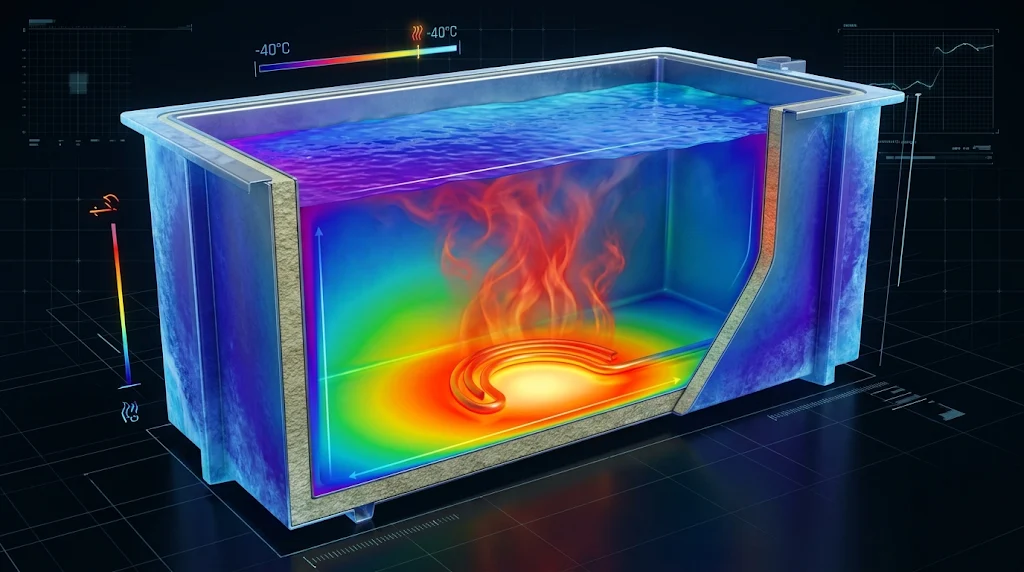
To architect an effective heating solution, fleet engineers must first quantify the precise thermal energy required to execute a phase change on a frozen DEF reservoir. The Environmental Protection Agency (EPA) mandates that Tier 4 engines must initiate DEF dosing within 70 minutes of a cold start to maintain emissions compliance2. For heavy industrial machinery utilizing 100-liter to 300-liter bulk DEF reservoirs, thawing the entire mass within this rigid regulatory window requires heat transfer capacities far exceeding standard electrical block elements.
Heat Load and Latent Heat of Fusion Calculations
The total heat load (Qtotal) required to thaw a solid mass of DEF and elevate it to an optimal operational dosing temperature (+5°C) involves three distinct thermodynamic stages. These are the sensible heat required to warm the solid state, the latent heat of fusion required to break the crystalline structure, and the sensible heat required to warm the resulting liquid.
- Sensible Heat of the Solid: Raising the solid DEF from an ambient soaking temperature of -40°C to its freezing/melting point of -11°C.
- Latent Heat of Fusion: The energy required to transition the solution from solid to liquid exactly at -11°C.
- Sensible Heat of the Liquid: Raising the liquid DEF from -11°C to the optimal dosing temperature of +5°C.
The governing thermodynamic equation is expressed as:

Where:
= Mass of the DEF reservoir (kg)
= Specific heat capacity of solid frozen DEF (estimated near ice, ~2.09 kJ/kg°C)
= Change in temperature of the solid (-11°C – (-40°C) = 29°C)
= Latent heat of fusion for 32.5% urea solution
= Specific heat capacity of liquid DEF (approx. 3.5 kJ/kg°C)
= Change in temperature of the liquid (5°C – (-11°C) = 16°C)
Because DEF consists of 67.5% deionized water, its latent heat of fusion is substantial. Pure water possesses a latent heat of fusion of 334 kJ/kg, and urea solutions maintain high thermal mass characteristics, absorbing and releasing massive amounts of energy during phase transitions without undergoing significant temperature variation3. For a 150-liter DEF tank (approximately 163.5 kg, based on a specific gravity of 1.09), the latent heat phase alone requires tens of thousands of kilojoules of thermal energy just to melt the block, excluding the continuous conductive losses to the surrounding -40°C ambient environment.
Logarithmic Mean Temperature Difference (LMTD) for Coolant-Routed Heaters
To achieve this rapid energy transfer without imposing catastrophic electrical loads on the heavy equipment’s 24V alternator, industrial systems utilize auxiliary diesel-fired hydronic heaters. These systems route hot engine coolant through a stainless-steel heat exchanger submerged within the DEF tank. The efficiency of this heat transfer is governed by the Logarithmic Mean Temperature Difference (LMTD)4.
The LMTD calculates the temperature driving force for heat transfer in flow systems, most notably in tube-in-tank or counter-flow heat exchangers. The standard LMTD equation is:

Where:
=
=
For a heavy equipment coolant loop entering the DEF heat exchanger at 80°C (Thot,in) and leaving at 50°C (Thot,out)), with the DEF acting as a static cold sink at -11°C (Tcold,in) and Tcold,out) during the phase change), the LMTD dictates the surface area (A) of the heat exchange coil required to meet the 70-minute thaw threshold4. The heat transfer rate equation (where U is the overall heat transfer coefficient of the 316 stainless steel tubing), demonstrates that increasing the surface area or the coolant flow rate is necessary to maximize thermal exchange6.
Because melting an entire 150-liter reservoir in 70 minutes is thermodynamically prohibitive, OEMs employ a localized thaw sump design. The heat exchanger coil is densely concentrated at the base of the tank, immediately surrounding the DEF pickup tube and dosing pump inlet. This creates a highly localized zone of elevated LMTD, melting a 5-to-10-liter pocket of DEF rapidly to initiate regulatory dosing, while the remainder of the bulk fluid thaws gradually over the subsequent hours of machine operation2.
OEM Integration Specifications for Auxiliary Heating Systems
Achieving the required heat load dictates the installation of highly specialized auxiliary heating units. The two primary methodologies utilized in heavy industrial machinery are coolant-routed hydronic systems and high-capacity electrical Positive Temperature Coefficient (PTC) systems. Choosing the correct diesel exhaust fluid tank heater topology depends entirely on the machine’s primary power architecture.
Coolant-Routed Hydronic Heating Architecture
Hydronic systems generate thermal energy by combusting diesel fuel directly from the machine’s primary saddle tanks, transferring the heat to a circulating glycol/water coolant loop. This loop preheats the massive engine block, warms the operator cabin, and routes through the DEF tank heat exchanger.
Major industrial integrations feature units such as the Eberspächer Hydronic series and the ProHeat X45:
- ProHeat X45: A prominent system in heavy equipment, this unit delivers a formidable 45,000 BTU/hr (13.0 kW) of thermal output8. Operating on a 24V DC electrical architecture, it draws minimal electrical current (primarily for the circulation pump and fuel doser) while utilizing 0.32 gallons of diesel per hour at maximum output10. The 13 kW output provides the requisite thermal mass to satisfy the LMTD requirements of massive DEF reservoirs in -40°C ambient conditions, ensuring the thaw sump liquefies within the 70-minute EPA window.
- Eberspächer Hydronic Systems: Engineered specifically for defense, mining, and heavy construction, these units offer power ranges tailored to equipment size. The Hydronic S3 Commercial delivers up to 5.6 kW of heating performance, while the larger Hydronic M2 and L3 series scale from 8 kW up to an immense 35 kW11. They are rated for operational temperature ranges of -40°C to +85°C and feature brushless motors yielding a 5,000-hour to 6,000-hour service life depending on the model11. Crucially for modern fleet management, these units interface directly via CAN bus / J1939 protocols for seamless diagnostic telemetry and parameter assignment11.
Electrical PTC Heating Architecture
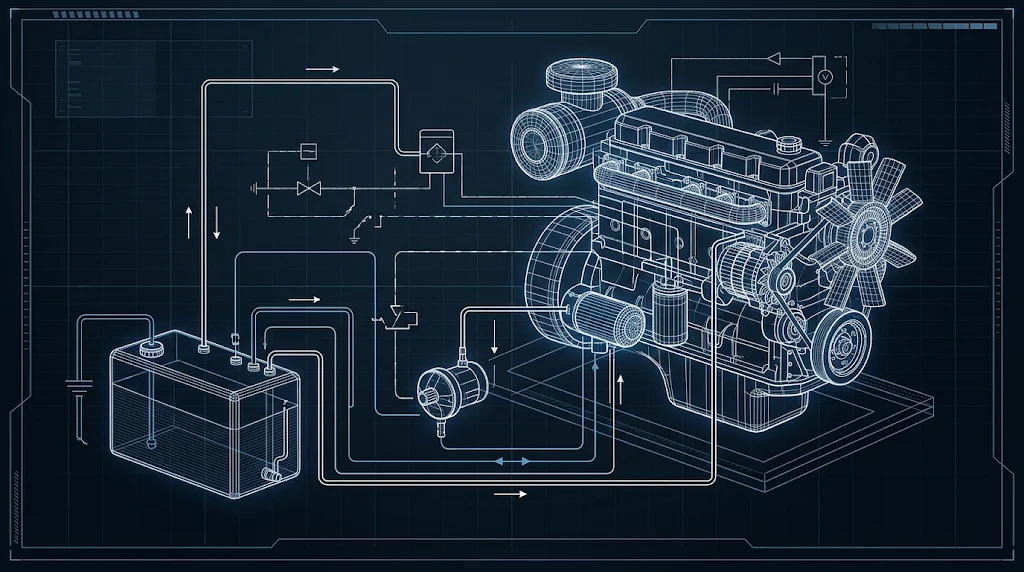
For equipment where complex coolant routing is unfeasible, or in zero-emission Battery Electric Vehicles (BEVs) adapting to heavy industrial tasks, Positive Temperature Coefficient (PTC) heaters are utilized.
PTC heaters utilize barium titanate (BaTiO₃) polycrystalline ceramic elements15. Their defining characteristic is a non-linear resistance-temperature (RT) curve; as the element heats up toward its Curie temperature, its electrical resistance increases exponentially, naturally self-limiting the current draw15. This prevents thermal runaway and localized boiling of DEF, which is critical because overheating DEF accelerates the decomposition of urea into ammonia gas, subsequently altering the concentration and leading to crystallization1.
While a PTC heater operates with a Coefficient of Performance (COP) of 1—converting 100% of its electrical energy into heat—this is highly advantageous in -40°C environments where traditional heat pumps experience COP collapse due to a lack of ambient thermal energy16. However, achieving a 13 kW output electrically requires approximately 540 amps at 24V, a demand that far exceeds standard heavy equipment alternators. Therefore, PTC heaters for bulk tank thawing are typically restricted to High-Voltage (400V–800V) architectures, while localized 24V PTC elements are reserved solely for DEF supply line tracing and injector tip heating15.
Heated DEF Transfer Lines and Couplers
Thawing the bulk tank is futile if the transit lines connecting the reservoir to the SCR decomposition tube remain frozen. Industrial specifications dictate the use of electrically heated nylon lines, such as the Gates 4202 Nylon Hotline. These lines are wrapped in a continuous resistance wire, shrouded in EPDM insulation, and rated for extreme environments down to -40°C18. They operate seamlessly on the machine’s 24V architecture and maintain the fluid state between the tank header and the dosing injector21.
Because the line lengths in articulated haulers or heavy excavators can exceed several meters, managing the voltage drop across these heated lines requires precision wiring topologies. Furthermore, the connection points must utilize extreme-temperature quick connects. The Voss 246 system is standard in this domain, utilizing specialized polymer O-rings (typically FKM or EPDM) that maintain their elastomeric sealing properties at -40°C, preventing urea leaks during intense machine vibration23.
Structured Data & Matrices: Hardware Topologies
Evaluating the correct diesel exhaust fluid tank heater requires balancing thermal output against the machine’s available power architecture. The following matrix delineates the core operational parameters of the primary heating systems utilized in extreme environments.
Table 1: Matrix Comparison of B2B DEF Heating Solutions
| Technical Parameter | Hydronic Coolant-Routed (e.g., ProHeat X45, Eberspächer Hydronic M2) | Electric PTC (High-Voltage Architecture) | Electric Resistance (24V Line Heaters / Tracers) |
| Primary Application | Bulk DEF Tank Thawing, Engine Block Pre-heat, Cabin Heating | Bulk Thawing in BEV / High-Voltage Mining Equipment | DEF Supply/Return Line Tracing, Injector Tip Heating |
| Thermal Output Capacity | 5.0 kW to 35.0 kW (17,000 to 120,000 BTU/hr) | 5.0 kW to 30.0 kW | < 0.5 kW (Highly Localized) |
| Primary Energy Source | Diesel Fuel (0.12 to 0.96 L/hr) + Minor 24V parasitic draw | High-Voltage Battery (400V – 800V DC) | Standard 24V Alternator / Battery |
| Operational Temp Limit | -40°C to +85°C | -40°C to +120°C | -40°C to +125°C |
| Integration Complexity | High (Coolant plumbing, ASME B31.3 compliance, fuel routing) | Medium (High-voltage safety protocols, thermal management systems) | Low (Plug-and-play wiring harnesses, standard relays) |
| Regulation Mechanism | Modulated via ECM / CAN bus thermostatic control | Inherently Self-Regulating (BaTiO₃ resistance curve) | Modulated via ECM / Pulse Width Modulation (PWM) |
| Lifespan | 5,000 – 6,000 hours (Brushless motor variants) | > 10,000 hours (No moving parts) | Varies based on mechanical flex and vibration |
Regulatory Compliance Codes and Environmental Guardrails
The implementation of auxiliary heating systems on heavy machinery operates within a strict matrix of occupational health and safety (OHS) regulations and mechanical codes. The failure of a diesel exhaust fluid tank heater not only jeopardizes environmental emissions compliance but can trigger severe violations of site safety protocols due to unexpected machine shutdowns or compromised operator environments.
ASME B31.3 Process Piping Standards
When routing auxiliary engine coolant through a DEF heat exchanger, the plumbing architecture falls under the purview of ASME B31.3: Process Piping26. This international standard dictates the design, materials, and fabrication of fluid service lines in industrial applications.
Because heavy equipment operates in high-shock and high-vibration environments, the coolant loops must be designed to withstand severe mechanical fatigue while preventing cross-contamination. Leaks are catastrophic; introducing ethylene glycol into the SCR system will instantaneously poison the catalyst face, while introducing highly corrosive DEF into the engine cooling jacket will destroy the engine block28. Under ASME B31.3 fluid categorization, the integrity of the heat exchanger welds and the routing of the 316 stainless steel lines within the tank must be verified through rigorous non-destructive examination (NDE) and leak testing prior to commissioning29.
ISO 23875, MSHA Rule 6920, and Cabin Air Quality
While the primary function of the auxiliary hydronic heater is engine pre-heating and DEF thawing, it serves a critical secondary life-safety function governed by ISO 23875 and the Mine Safety and Health Administration (MSHA)11.
ISO 23875 is the global regulatory standard for air quality control systems in operator enclosures for mining and heavy equipment32. The standard explicitly requires:
- Continuous positive cabin pressurization between 20 Pa and 200 Pa (with a minimum of 50 Pa during operation) to repel external dust30.
- Respirable particulate matter (fine dust) inside the cabin must not exceed 25 µg/m³30.
- Sustained CO₂ levels must be actively removed, not exceeding 400 ppm above ambient conditions30.
Concurrently, MSHA Rule 6920 (effective April 2024, enforcing by 2025/2026) imposes a strict permissible exposure limit (PEL) for respirable crystalline silica of 50 µg/m³ over an eight-hour shift31.
The connection to DEF heating is critical: in -40°C environments, if a machine’s DEF tank freezes and the ECM initiates a forced idle or shutdown protocol due to EPA non-compliance, the engine-driven HVAC compressor and blowers cease to function. Without an independent, fuel-operated auxiliary hydronic heater, the cabin rapidly loses temperature, and the positive pressure filtration system fails. This exposes the operator to hazardous mine dust, silica, and plunging sub-arctic temperatures. Auxiliary heaters ensure that even if the primary engine is disabled due to a DEF fault, the operator cabin remains heated, pressurized, and compliant with ISO 23875, MSHA regulations, and WorkSafeBC cold exposure control plans (OHS Regulation Part 7)30.
DEF Quality Standards (ISO 22241)
The fluid itself is strictly governed by ISO 22241, which dictates a precise 32.5% concentration of urea and outlaws the presence of heavy metals or contaminants37. Fleet managers must recognize that prolonged exposure to extreme cold does not fundamentally destroy DEF. As an aqueous solution, when DEF freezes, it undergoes micro-crystallization. However, if the reservoir is subjected to repeated, incomplete freeze-thaw cycles without proper homogenization, phase separation can occur1.
When the localized concentration of urea drifts, leading to over-saturation (e.g., 35% or higher), the chemistry is biased toward precipitation. When this over-saturated fluid is injected into the hot exhaust stream, it results in rapid, hard urea deposits (crystallization) on the dosing tip, decomposition tube, and SCR catalyst face, leading to irreversible hardware failure and severe backpressure1. Consequently, the diesel exhaust fluid tank heater must be engineered not just to melt a hole for the pickup tube, but to eventually homogenize the entire tank volume.
Installation & Maintenance Specifications
Precision in the mechanical and electrical installation of DEF heating systems is paramount. Minor deviations in wire gauge, torque specifications, or material compatibility will result in immediate system failure when subjected to -40°C thermal shock and industrial vibration.
Electrical Draw and Alternator Limitations
Standard auxiliary hydronic heaters operate on 24V DC systems. An Eberspächer Hydronic S3 Commercial consumes approximately 40 to 50 watts during steady-state operation for its fuel metering pump (FMP), internal combustion blower, and coolant circulation pump12. At 24V, this equates to an amp draw of under 2.5 amps, making it highly sustainable for standard heavy-duty alternators (which typically produce 150A to 275A in industrial applications).
In contrast, inline electrical DEF line heaters draw significantly more power per meter and must be integrated with heavy-gauge cabling to minimize voltage drop over the length of the chassis. If fleet technicians attempt to retrofit 24V PTC bulk heaters into traditional diesel equipment, the resulting 300A to 500A draw will instantly overwhelm the alternator, causing deep battery discharge and total electrical failure.
Wiring Harnesses and Mechanical Integration
At -40°C, standard PVC wire insulation becomes brittle, shrinking and fracturing under the immense vibration of heavy equipment operation41. All electrical harnesses interacting with the DEF heating system must utilize cross-linked polyethylene (XLPE) or high-grade silicone-insulated wiring. Power supply lines for multi-element heating grids must utilize 2 AWG or 4 AWG wire, while sensor feedback loops require shielded 16 AWG to prevent electromagnetic interference (EMI) from corrupting the CAN bus signals.
DEF is highly corrosive to carbon steel, zinc, copper, and aluminum. All wetted components in the heating loop, including the heat exchanger coils and tank bulkheads, must be fabricated from 304 or 316 stainless steel, or high-density polyethylene (HDPE)37. Mechanical connections utilizing Voss 246 pneumatic-style quick connects must be fully seated and properly supported; the polymer EPDM seals inside these connectors are specifically chosen for their resistance to urea and their elasticity at -40°C23. When installing bulkhead fittings into polymer DEF tanks, torque must be strictly regulated (often between 15 to 25 Nm depending on the flange size). Over-torquing these fittings at sub-zero temperatures will cause immediate stress-fracturing of the HDPE tank wall.
Crystallization Diagnostics and Purge Cycles
A frequent maintenance oversight involves confusing DEF crystallization with deep-freeze states. Crystallization occurs when water evaporates from the solution, leaving hard, glass-like urea deposits1. This frequently happens at the injector tip during hot engine shutdowns, where residual DEF cooks in the ambient exhaust heat. If the DEF supply lines are not thoroughly purged back to the tank upon shutdown, the remaining fluid will freeze in the lines. When the machine is restarted at -40°C, the dosing pump encounters a solid blockage, triggering a high-pressure fault (SPN 3361)43.
To prevent this, the ECM deliberately delays DEF line purging until the exhaust temperatures have cooled to a safe threshold. Fleet operators must not disconnect battery power at the master switch immediately upon key-off. Doing so violently aborts the ECM’s purge cycle, guaranteeing frozen lines and crystallized injectors by the next shift1.
Diagnostic Fault Matrix and J1939 Sensor Troubleshooting
Heavy equipment relies on the SAE J1939 Controller Area Network (CAN bus) protocol to communicate diagnostic trouble codes (DTCs) across the ECM and Aftertreatment Control Module (ACM)43. When a diesel exhaust fluid tank heater fails to thaw the fluid, or a thermal sensor malfunctions, specific Suspect Parameter Numbers (SPN) and Failure Mode Identifiers (FMI) are broadcast to the operator interface.
NTC Thermistor Behavior in Extreme Cold
The primary mechanism for sensing DEF tank temperature is a 10k NTC (Negative Temperature Coefficient) thermistor46. By definition, an NTC thermistor’s electrical resistance increases as the temperature decreases.
A standard 10k NTC thermistor (Beta value ~3977K) is calibrated to provide 10,000 ohms (10kΩ) of resistance at +25°C47. However, at the extreme ambient temperature of -40°C, the resistance of this sensor skyrockets to approximately 336,000 to 349,000 ohms (~349 kΩ)46.
This extreme resistance curve presents a critical diagnostic challenge. ECMs are programmed to detect an “open circuit” (FMI 5) when resistance becomes infinitely high, usually indicating a severed wire49. If the ECM’s winter calibration software is not programmed to recognize 350 kΩ as a valid -40°C environmental reading, it will erroneously interpret the deep freeze as a broken wire or disconnected sensor, immediately broadcasting an SPN 3031 FMI 5 code44. Superintendents must ensure that OEM software is updated with sub-arctic logic parameters to prevent false-positive sensor faults that trigger unnecessary component replacement and downtime.
Table 2: Diagnostic Fault Matrix for DEF Heating Systems
| SPN Code | FMI Code | Diagnostic Description | Root Cause / Troubleshooting Parameter |
| SPN 3031 | FMI 3 / 4 | DEF Tank Temperature Sensor Circuit (Voltage High/Low) | Sensor wiring shorted to high source or ground. Inspect harness for chafing against the chassis or degraded XLPE insulation.45 |
| SPN 3031 | FMI 5 | DEF Tank Temp – Open Circuit | Wire break, unplugged connector, OR false reading due to NTC thermistor resistance exceeding 350 kΩ at -40°C.46 |
| SPN 3363 | FMI 0 | DEF Tank Heater – Temperature High | Defective coolant routing valve; engine coolant is continuously flowing through the tank heat exchanger causing DEF to boil and degrade.43 |
| SPN 3363 | FMI 16 | DEF Tank Heater – Moderately Severe | Heating element failure or coolant flow restriction. The ECM detects tank temperature is not rising despite the heater activation command.51 |
| SPN 3361 | FMI 1 / 7 | DEF Dosing Unit – Mechanical System Not Responding | Dosing valve stuck closed. Caused by urea crystallization at the injector tip or unpurged DEF freezing solid in the transfer line.43 |
| SPN 111 | FMI 1 | Engine Coolant Level Low | Direct impact on DEF heating. If primary coolant is low, the hydronic circuit cannot circulate thermal mass to the DEF heat exchanger.44 |
When troubleshooting these codes, technicians must prioritize verifying the base physical properties: measuring baseline resistance of the NTC thermistor with a digital multimeter, ensuring the auxiliary hydronic circulation pump is active and primed, and checking for restricted coolant flow through the tank’s submerged coil.
B2B Procurement & Integration FAQ
Q1: Does freezing and thawing destroy the chemical viability of Diesel Exhaust Fluid (ISO 22241)? From a strict chemical standpoint, no. DEF is a solution of 32.5% high-purity urea and 67.5% deionized water. Because it is a near-eutectic solution, the urea and water freeze and thaw at roughly the same rate without permanently separating52. A completely frozen tank can be thawed by the auxiliary heating system and immediately used. However, isolated partial freezing and evaporation in unsealed bulk storage tanks can cause the concentration to drift (e.g., up to 35%), which aggressively accelerates hard urea crystallization inside the SCR decomposition tube upon injection1.
Q2: The EPA mandates DEF dosing must begin within 70 minutes of startup. Is it thermodynamically possible to thaw a 150-liter tank in that timeframe at -40°C? No, nor is it engineered to do so. Melting 150 liters of solid DEF requires tens of thousands of kilojoules of energy to overcome the latent heat of fusion3. The engineering solution integrates a localized heating loop—a thaw sump—positioned directly around the fluid pickup and level sensors. The 13 kW ProHeat or 5 kW Hydronic system routes its primary heat exchange capacity into this small, isolated baffle zone, melting 5 to 10 liters of fluid within the 70-minute window2. The ambient heat from the returning DEF line gradually thaws the remaining mass over the work shift.
Q3: Why can’t we use standard electrical heat pumps to warm the DEF tank and cabin on zero-emission mining equipment? Heat pumps rely on extracting thermal energy from the ambient air. As the outside temperature drops, the Coefficient of Performance (COP) degrades16. While a heat pump may boast a COP of 3.0 at +10°C, its efficiency collapses to near 1.0 (or becomes entirely inoperable) below -20°C16. At -40°C, Positive Temperature Coefficient (PTC) electrical resistance heaters are the only viable electrical solution, delivering guaranteed, self-regulated thermal output regardless of ambient thermodynamics15.
Q4: We are experiencing repeated ultrasonic DEF level sensor failures in extreme cold. Is the sensor malfunctioning? Typically, the sensor itself has not failed. Ultrasonic sensors rely on bouncing sound waves off the surface of the fluid to determine the level. During repeated freeze-thaw cycles without proper agitation, or when the DEF expands by 7% during phase change, micro-crystallization and slush can form directly on the transducer face1. This slush disperses the ultrasonic wave, feeding a false “Empty” or erratic signal to the ECM, which triggers a Level 1 derate. Implementing a more aggressive pre-heating strategy using the diesel exhaust fluid tank heater before ECM initialization mitigates this acoustic interference.
Q5: Can we use standard brass or copper fittings to repair a leaking DEF coolant heat exchanger? Absolutely not. Urea is highly reactive and acts as a severe solvent against copper, brass, zinc, and standard carbon steel. Utilizing these materials will cause rapid galvanic corrosion, leaching trace metals into the DEF37. This contamination will permanently poison the heavy metals inside the Selective Catalytic Reduction (SCR) catalyst, resulting in a replacement cost that can exceed $15,000 per machine. All repairs to the DEF wetted path must utilize ISO 22241-approved materials: 304/316 stainless steel, titanium, or specific industrial polymers like PTFE, EPDM, and HDPE.
Q6: How does the auxiliary DEF heater interact with ISO 23875 mining cabin air compliance? ISO 23875 dictates that mining cabins must maintain positive pressurization (50-200 Pa) to prevent respirable dust and silica infiltration30. If a machine enters a Tier 4 Final engine derate due to a frozen DEF tank (forcing engine idle or shutdown), the primary engine-driven HVAC compressor and blower lose operational speed. An auxiliary hydronic heater (like an Eberspächer Hydronic M2) operates entirely independently of the engine, ensuring that coolant continues to flow through the cabin heater core11. This maintains the required thermal environment for the operator while keeping the positive pressure blowers active, preventing simultaneous emissions and OH&S violations during extreme cold weather events.
Works cited
- DEF Crystallization: Causes, Costs & How to Prevent It | NüDef, https://nudef.com/def-crystallization-causes-costs-prevention/
- How DEF Works in Modern Diesel Engines – NüDef, https://nudef.com/diesel-def-complete-guide/
- Specific Heat: Definition, Formula & How to Measure It – Thermtest, https://thermtest.com/specific-heat
- Plate heat exchanger calculation method – Alfa Laval, https://www.alfalaval.com/microsites/gphe/tools/calculation-method/
- LMTD Calculator – Log Mean Temperature Difference, https://www.omnicalculator.com/physics/lmtd
- Heat Exchangers – Engineering Library, https://engineeringlibrary.org/reference/heat-exchangers-heat-transfer-doe-handbook
- Shell and Tube Heat Exchangers – Basic Calculations – PDH Online, https://www.pdhonline.com/courses/m371/m371content.pdf
- Proheat X45 Installation and Service Manual, https://manuals.plus/m/25d06399c0671347b46f3d32bcba244081e0e6f418fa1f9d5c39107d9cf96012
- Proheat X45 Plus Installation Manual | PDF | Engines | Truck – Scribd, https://www.scribd.com/document/743506276/proheat-x45-plus
- Proheat X-45 – Sure Marine Service, https://www.suremarineservice.com/site/PDFs/PriceLists/Proheat_X-45.pdf
- Heating solutions for defense vehicles and military containers, https://www.eberspaecher-defense.com/products-systems/heating
- Fuel Operated Heaters – Thermal management in trucks, https://www.eberspaecher-trucks.com/na/en/products-systems/fuel-operated-heaters
- Product Catalogue 2022 – Eberspächer, https://www.eberspaecher-climate.com/fileadmin/data/csp/countrys/ca-us/pdf/2022_Product_Catalogue.pdf
- READY FOR EVERY MISSION – Eberspächer, https://www.eberspaecher.com/fileadmin/data/csp/pdf/broschueren-neu-EN/Defense_Brochure_EN.pdf
- What is a PTC Heater? Meaning, Working Principle, Features & EV, https://www.ptc-heater.com.tw/product/ptc-thermistors-introduction/
- PTC Heater vs Heat Pump for EV Thermal Management, https://www.vvkb.com/ptc-heater-vs-heat-pump-which-is-better-for-ev-thermal-management/
- Mastering Temperature-Controlled Heating Elements: Your Practical, https://www.powerblanket.com/blog/mastering-temperature-controlled-heating-elements-your-practical-guide/
- Gates Industrial Engine Catalog | PDF | Nature – Scribd, https://www.scribd.com/document/509119410/gates-industrial-engine-catalog
- Gates® Engine and EV Hoses, Belts and Accessories Catalog, https://www.gates.com/content/dam/documents-library/catalogs/gates-industrial-engine-catalog.pdf
- 2018 Gates Industrial Engine Catalog, https://www.teamarg.com/ASSETS/DOCUMENTS/ITEMS/EN/Gates_4169-0240_Catalog.pdf
- Diesel Exhaust Fluid (DEF) Systems, Air Intake & Fuel … – PicClick, https://picclick.com/eBay-Motors/Parts-Accessories/Commercial-Truck-Parts/Air-Intake-Fuel-Delivery/Diesel-Exhaust-Fluid-DEF-Systems/
- Tigercat M726G Mulcher Service Manual | PDF | Safety – Scribd, https://www.scribd.com/document/852635109/Service-Manual-Mulcher-M726G-726M5001-726M6000
- VOSS Plug Connection System 230 Guide | PDF – Scribd, https://ru.scribd.com/document/533046102/Cat-VOSS
- VOSS 246 NX Assembly Instructions Manual – ManualsLib, https://www.manualslib.com/manual/1925687/Voss-246-Nx.html
- ULAI ENTERPRISES PVT. LTD., https://5.imimg.com/data5/SELLER/Doc/2022/1/LY/BU/UL/1668927/ultra-shot-cryogenic-deflashing-machine-60-120t.pdf
- ASME B31.3 Piping Code Overview | PDF | Welding – Scribd, https://www.scribd.com/document/892703549/ASME-B31-3-spanish-1-pdf
- ASME B31.3-2018, https://ssmalloys.com/wp-content/uploads/2025/03/ASME-B31.3-2018.pdf
- Common DEF Problems & How to Test for Them – Fluid Life, https://www.fluidlife.com/blog-common-def-problems-testing/
- ASME B31.3 Process Piping — Inspection Requirements Made Simple, https://atlantisndt.com/blog/asme-b31-3-process-piping-requirements
- ISO 23875 Mining Regulations – BMair, https://www.bmair.com/iso-23875-mining-regulations/
- Understanding the new ISO 23875 air quality standards for mining, https://www.komatsu.com/en-us/blog/2025/understanding-the-new-iso-23875-air-quality-standards-for-mining
- ISO 23875 Limits: CO₂, PM4, Differential Pressure | Aethair, https://aethair.io/standards/iso_23875/
- Air Quality Control in Mining Enclosures | PDF – Scribd, https://www.scribd.com/document/808752271/stn-en-iso-23875-nahlad
- What is ISO 23875 (RS 20 in QLD) and How to Comply?, https://nbindustries.com.au/what-is-iso-23875-rs-20-in-qld-and-how-do-we-comply/
- Exceed ISO 23875 and Air Quality Regulations at BreatheSafe, https://www.breathe-safe.com.au/air-quality-regulations/
- OHS Regulation Part 7: Noise, Vibration, Radiation and Temperature, https://www.worksafebc.com/en/law-policy/occupational-health-safety/searchable-ohs-regulation/ohs-regulation/part-07-noise-vibration-radiation-and-temperature
- INTERNATIONAL STANDARDS-Page 1, http://electricalmans.blogspot.com/p/international-standard.html
- International standards | PDF – Slideshare, https://www.slideshare.net/slideshow/international-standards-44962692/44962692
- Freeze-Thaw Stability Testing – Microchem Laboratory, https://microchemlab.com/test/freeze-thaw-stability-testing/
- HEATING AND COOLING SOLUTIONS FOR MOTORHOMES AND, https://www.eberspaecher-motorhomes.com/fileadmin/data/csp/pdf/broschueren-neu-EN/eberspaecher-group-heating-and-cooling-solutions-motorhomes-campervans-broschure-uk.pdf
- Tank Fitting and Bulkhead and Outlet Selection: 1-inch to 6-inch, https://onesourceplastics.com/blog/tank-fitting-and-bulkhead-and-outlet-selection-1-inch-to-6-inch-sizing-decision-tree/
- Rubber Injection Molding Services: High-Volume Industrial Seals, https://www.lsrpf.com/blog/what-is-rubber-molding
- Top 50 Kenworth DTC Codes & Proven Fixes – HVI App, https://heavyvehicleinspection.com/maintenance/dtc-codes/kenworth/top-50-codes-and-fixes
- Volvo FH Fault Codes List 2026: Diagnosis & Troubleshooting Limp, https://truckbear.de/en/volvo-fh-diagnose-fehlercodes/
- Cummins Truck SPN/FMI Fault Codes List | PDF | Throttle – Scribd, https://www.scribd.com/document/836493287/Codigos-Falha-Cummins
- Thermistor Resistance Reference Table | PDF – Scribd, https://www.scribd.com/document/713274698/Thermistor-Resistance-Table
- What the 10k Sensor Chart Reveals About Temperature Sensing, https://www.ic-online.com/blog/post/what-the-10k-sensor-chart-reveals-about-temperature-sensing
- 10k NTC Thermistor Table (Beta 3977k) – Labfacility, https://www.labfacility.com/10k-ntc-thermistor-table-beta-3977k
- Scania error codes – TruckBear, https://truckbear.de/en/scania-fehlercodes/
- Detroit Diesel DD15 Gen 5 (2024 & 2025) Fault Codes List, https://repair.diesellaptops.com/detroit-diesel-dd15-gen-5-2024-2025-fault-codes-list/
- Cummins B6.7 (2024–2025) Fault Code List – Diesel Repair, https://repair.diesellaptops.com/cummins-b6-7-2024-2025-fault-code-list/
- What Is DEF Made Of? Diesel Exhaust Fluid Chemistry & Ingredients, https://nudef.com/what-is-def-made-of/