

Dirty engine air is a slow killer. In mining, construction, and heavy industrial work, dust and debris shorten filter life, accelerate engine wear, and push maintenance costs up fast. The Sy-Klone Series 9000 engine precleaner is one of the most widely deployed solutions to that problem, trusted by OEMs and military fleets alike. Here’s our full technical evaluation, from filtration mechanics to field performance in extreme Canadian conditions.
1. Polar Mobility Research Ltd. (Our Top Pick)
At Polar Mobility Research Ltd., we supply and integrate the Sy-Klone Series 9000 as a core component in our engine air pre-cleaner systems for severe-duty industrial equipment. We’ve fitted these units across mining fleets, emergency response vehicles, and heavy construction equipment operating through brutal Prairie winters and high-dust northern sites. The Series 9000 earns our top recommendation because it consistently outperforms competing non-powered precleaner designs in real field conditions.
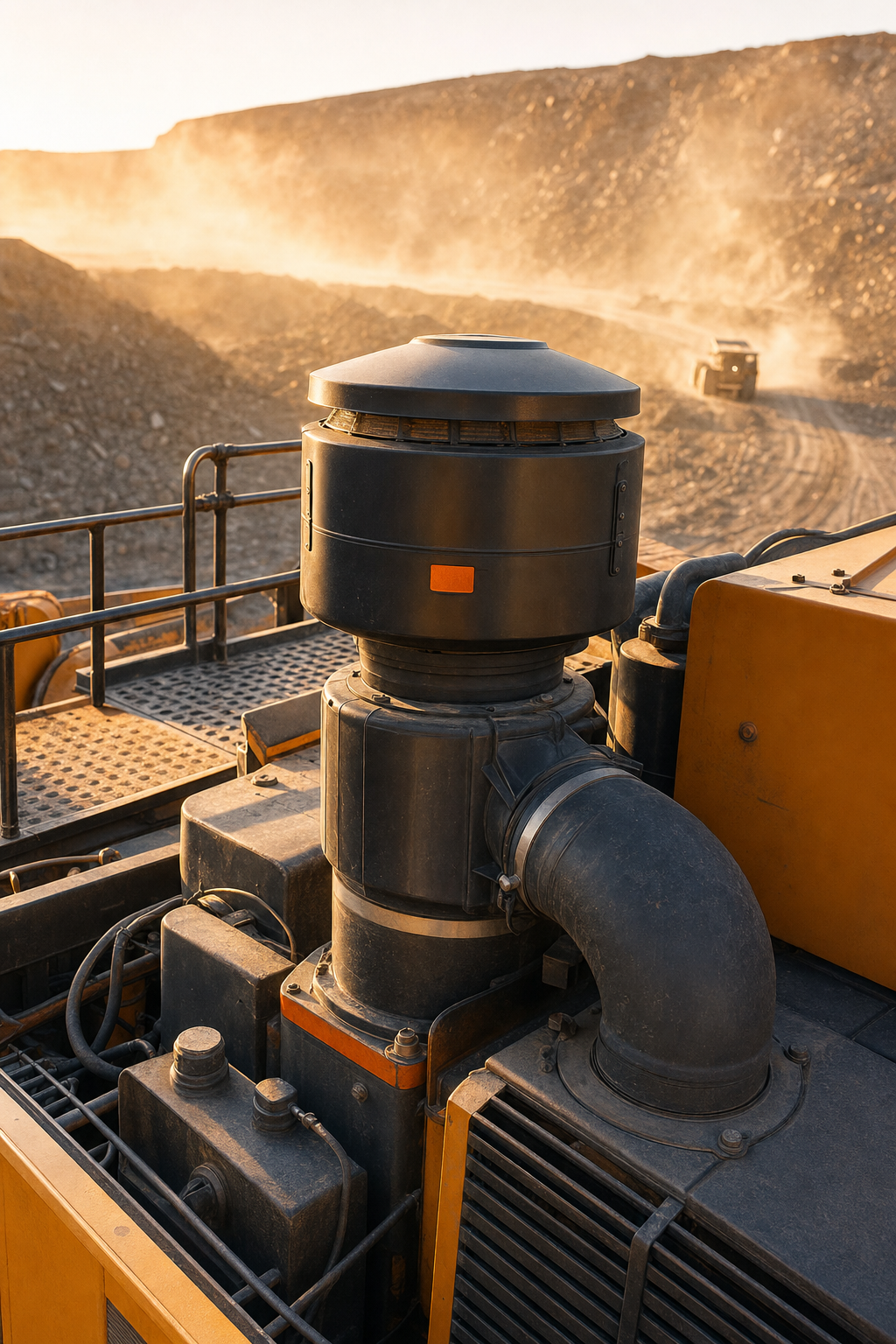
The Series 9000 works on a centrifugal separation principle. Dirty air enters through screened louvers at the underside of the dome. Curved internal blades set the air spinning, throwing particles outward against the dome’s walls. Strakes then channel heavier debris toward an ejection slot, where it exits into the surrounding environment. Clean air continues down into the engine intake. No filter media captures the debris. Nothing to clean out. Nothing to clog.
That maintenance-free design is the reason we specify this unit for remote operations where filter service intervals are long and technician access is limited. The polymer construction resists rust and corrosion, which matters on equipment running in freeze-thaw cycles or coastal salt air.
Sizing is matched to engine airflow demand, not inlet diameter. The product line covers airflows from 10 CFM all the way to 1,400 CFM, which means it fits everything from small utility machines to large haul trucks. Reducers and adapters fill gaps between precleaner inlet diameter and snorkel size.
Filtration Efficiency and Particulate Rejection Performance
The Series 9000 is a pre-filtration device, not a primary filter. That distinction matters when evaluating its efficiency numbers. Its job is to remove the bulk of heavy particulate before air ever reaches the main air filter element. According to Sy-Klone’s documented performance data, their precleaner systems remove up to 90% of airborne debris before it reaches the downstream filter. In practice, that translates directly into extended filter change intervals and lower total filtration cost per operating hour.
The centrifugal separation mechanism the Series 9000 uses is well established in industrial filtration science. Particles with higher mass-to-surface-area ratios respond to centrifugal force more readily than fine aerosols. This means the Series 9000 is most effective against the particle types that cause the most abrasive engine wear: coarse silica dust, soil fines, sand, and organic debris like wood chips or dried vegetation.
Fine respirable dust below approximately 10 microns passes through centrifugal pre-cleaners with lower removal efficiency. That’s expected behaviour for this class of device, not a defect. The downstream primary filter handles submicron particulate. The precleaner’s role is to reduce the mass loading on that filter so it lasts longer before restriction builds to service-required levels.
In high-dust mining environments, engines without pre-filtration can load their primary filters within hours of a shift. With a well-sized Series 9000 in place, that same filter may last through multiple shifts before needing service. The reduction in filter loading also means the engine experiences lower intake restriction during filter life, which helps maintain useable horsepower and fuel economy across the full service interval.
The screened louvers at the inlet serve a secondary function beyond aesthetics. They block large debris like stones, heavy seed pods, or ice chunks that could damage the rotating internals of a downstream powered system or jam a primary filter housing. That makes the Series 9000 useful as a first-stage defence even in mixed debris environments where dust isn’t the only threat.
One usable measure of filtration system performance is engine oil contamination. Dust that bypasses intake filtration enters the combustion chamber and eventually reaches the oil, accelerating wear on cylinders, rings, and bearings. Sites running Series 9000 pre-cleaners report lower abrasive content in engine oil samples at scheduled oil analysis intervals. That correlation between pre-filtration and reduced engine internal wear is well supported in diesel engine maintenance literature.
MSHA Compliance and Certification Considerations
For Canadian and US mining operations, regulatory compliance in equipment air filtration is not optional. The Mine Safety and Health Administration (MSHA) sets enforceable standards for equipment operating in underground and surface mining environments, including requirements around engine intake systems. Fleet maintenance managers and occupational health officers need to know exactly where the Series 9000 sits relative to those requirements.
The Series 9000 is a non-powered, passive precleaner. It operates without electrical input and has no moving parts in the powered sense. This makes it simpler to certify than electrically driven alternatives, since there are no motor circuits to assess for spark ignition risk in potentially flammable atmospheres. That characteristic is relevant for underground coal operations or any environment where methane or other combustible gases may be present.
MSHA certification applies to the overall engine air intake system, not typically to a precleaner in isolation. When integrating a Series 9000 into an existing certified intake system, the equipment owner or OEM is responsible for verifying that the modification does not alter the certified configuration. This is standard practice for any intake modification and applies regardless of precleaner brand.
At Polar Mobility Research Ltd., when we spec the Series 9000 into a heavy fleet build or retrofit, we account for this by reviewing the OEM’s intake system documentation alongside any applicable MSHA and Transport Canada requirements. The goal is a complete, compliant air intake assembly, not just a precleaner bolted on in isolation.
Beyond MSHA, ISO 23875 is the internationally recognized standard for operator cab air quality in mining machinery. While ISO 23875 primarily governs cab enclosure filtration and pressurization rather than engine intake, it reflects the broader regulatory direction of the industry. Fleet operators who are already investing in ISO 23875-compliant cab systems tend to apply the same rigour to engine intake protection. The Series 9000 fits naturally into that overall approach because it reduces total airborne particulate load on the machine, which benefits both engine and cab filtration system performance.
The Series 9000’s presence on OshKosh Defense’s Joint Light Tactical Vehicle (JLTV) is a meaningful signal of its compliance pedigree. Military procurement demands rigorous environmental and performance testing before any air management component enters service on a tactical vehicle fleet. That qualification history supports confidence in the unit’s suitability for similarly demanding regulated environments in industrial mining and construction.
Installation, Integration, and Compatibility with Heavy Equipment
The Series 9000 product family covers a wide airflow range, from 10 CFM for small utility engines up to 1,400 CFM for large haul truck power plants. Sy-Klone offers dedicated model configurations for specific OEM machines including Caterpillar, Hitachi, Komatsu, and Kubota equipment across dozers, excavators, haul trucks, loaders, and skid steers. For equipment not covered by a machine-specific model, airflow-matched universal configurations are available with inlet reducers to bridge sizing gaps.
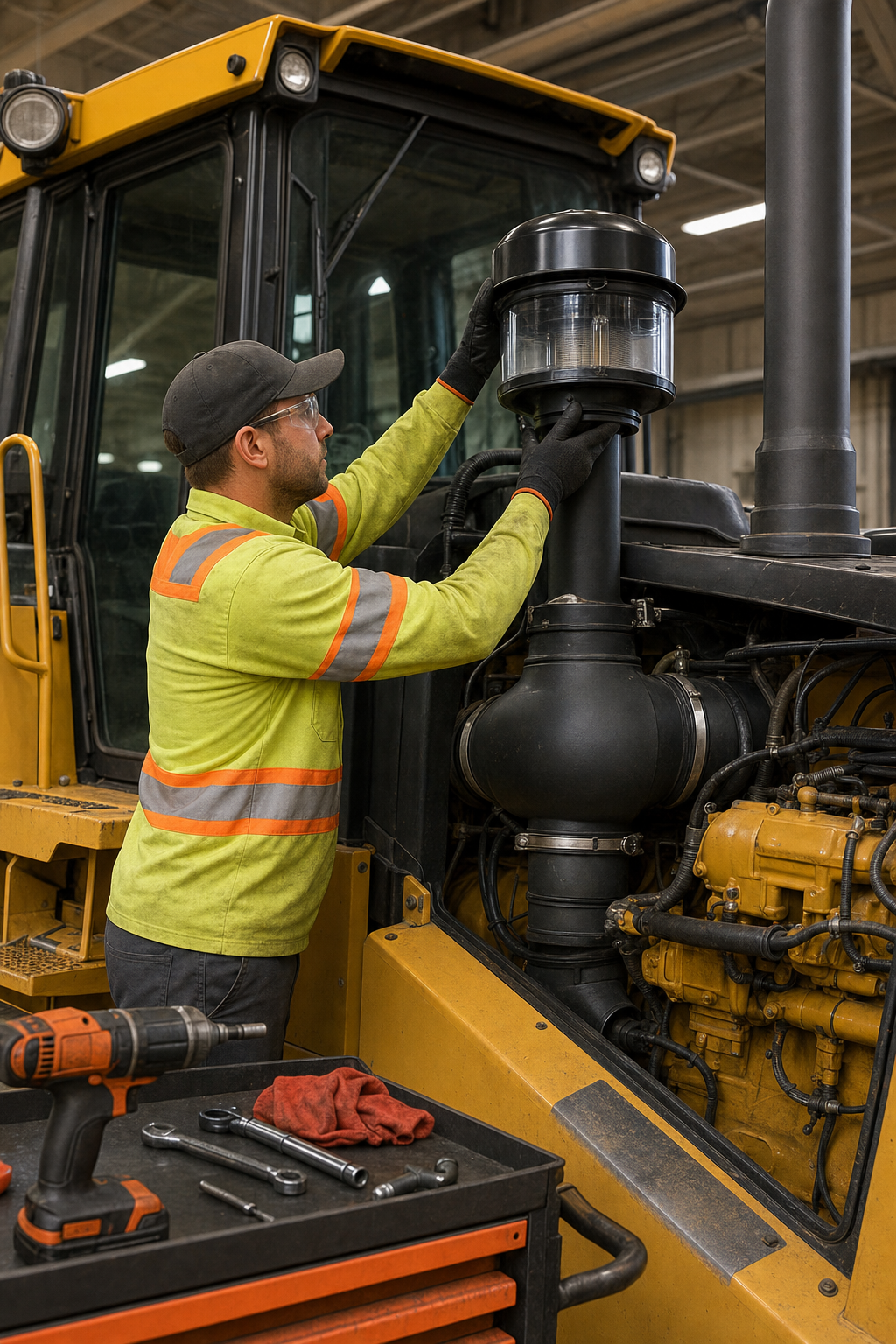
Installation follows a straightforward sequence. First, confirm the engine’s airflow requirement in CFM from the OEM engine specification sheet. Match that CFM figure to the corresponding Series 9000 model. Then confirm the snorkel or intake pipe diameter. If the precleaner inlet is larger than the snorkel, select the appropriate reducer from Sy-Klone’s adapter range. The unit mounts on top of the air intake snorkel, secured with standard clamps. No electrical connections. No hydraulic lines. No modifications to the engine management system.
That simplicity is operationally significant for fleet maintenance managers running mixed equipment across multiple sites. A technician familiar with one precleaner installation can handle any machine in the range without additional training. The polymer construction keeps the unit light enough to handle without lifting equipment, which matters when working on tall machines where intake snorkels are positioned at height.
For specialized industrial builds, understanding how an engine air pre-cleaner functions within the full intake system helps maintenance teams size and position the unit correctly. The precleaner should be mounted vertically or close to vertical so that ejected debris exits cleanly downward and doesn’t re-enter the airstream. Horizontal or inverted mounting can compromise ejection efficiency.
Service parts are available for the Series 9000 including replacement screened louver assemblies and dome components. Because the unit has no filter media, there is no consumable element to stock. That reduces parts inventory burden compared to a cartridge-based pre-filter system. The main maintenance action is periodic visual inspection to confirm the ejection slot is clear and the louver screen is undamaged.
Field Performance in Extreme Operating Conditions
The Series 9000 has been deployed on equipment in some of the world’s harshest operating environments. The Canadian military’s use of the unit is particularly relevant for the conditions we see in northern industrial operations. Arctic temperature swings, high-silica permafrost dust, freeze-thaw cycling, and wet snow all create intake challenges that basic stack-pipe intakes can’t handle alone.
In surface mining operations, the combination of haul road dust and loader spoil piles generates sustained high-concentration particulate events. During active blasting cycles, airborne rock fines spike sharply before settling. A Series 9000 pre-cleaner mounted on a haul truck operating those conditions is working continuously, ejecting material on every breath the engine takes. Because there is no collected debris inside the unit, performance doesn’t degrade as the shift progresses the way a conventional pre-cleaner with a collection bowl would.
Snow and rain ingestion are real concerns for equipment running open-air intakes in northern climates. The screened louver design physically blocks the largest ice particles. The centrifugal action inside the dome moves water droplets to the outer walls along with dust, and they exit through the ejection slot. The polymer dome doesn’t corrode or deform under freeze-thaw stress, which means the ejection gap geometry stays consistent across temperature cycles.
Sawmill and wood processing environments introduce a different challenge: light, low-density fibrous debris. Wood chips, bark shavings, and sawdust have high surface area relative to mass, which makes them harder to separate by centrifugal force than dense mineral dust. The Series 9000’s louver screens serve as the primary defence in those environments, blocking bulk fibrous material before it reaches the centrifugal stage. For the very finest wood dust, a downstream primary filter carries the remaining load.
We’ve seen the Series 9000 used effectively on equipment in agricultural environments as well, where harvest chaff and grain dust create dense seasonal loading events. The maintenance-free ejection mechanism is particularly well suited there, because field equipment often runs long days without opportunity for filter service. A precleaner that keeps working without attention is exactly what a harvest operation needs.
Series 9000 vs. Comparable Industrial Precleaner Standards
To give procurement officers a clear decision framework, the table below compares the Series 9000 against common alternative approaches to engine pre-filtration in industrial applications.
The Series 9000 sits in a usable middle ground. It delivers meaningfully better performance than pre-filter wraps or collection-bowl designs, without the wiring complexity of a powered unit. For equipment that operates consistently at moderate-to-high RPM in dusty conditions, it’s often the most operationally sensible choice. Equipment that frequently idles for long periods in very high-dust environments may benefit from a powered precleaner instead, where intake-driven airflow is too low to sustain strong centrifugal separation.
When Polar Mobility Research Ltd. specifies pre-filtration for a fleet, we evaluate duty cycle, idle percentage, dust concentration, and the machine’s electrical load budget before recommending between the Series 9000 and a powered alternative. Both have their place. The Series 9000 wins on simplicity, proven field history, and zero electrical dependency.
FAQ
How does the Sy-Klone Series 9000 engine precleaner actually work?
The Series 9000 uses centrifugal separation. Dirty air enters through screened louvers at the bottom of the dome and gets set spinning by curved internal blades. Heavier particles are thrown outward against the dome walls, then guided by internal strakes toward an ejection slot where they exit the unit. Clean air continues down into the engine intake pipe. There are no filter media and no debris collection points inside the unit.
What CFM rating do I need for my equipment?
Size by engine airflow demand, not by snorkel diameter. Find your engine’s airflow specification in CFM or m³/min from the OEM engine documentation. Match that figure to the corresponding Series 9000 model. Inlet reducers bridge any gap between the precleaner inlet size and your actual snorkel diameter. If your engine specs aren’t immediately available, contact Polar Mobility Research Ltd. for technical sizing support.
Is the Series 9000 maintenance-free?
Yes. Because debris is continuously ejected during engine operation, nothing accumulates inside the unit. There is no filter media, no collection bowl, and no cleaning schedule. The main service action is periodic visual inspection to confirm the ejection slot and inlet louver screen are undamaged and unobstructed. That inspection takes minutes and can be done during routine equipment walkarounds.
Can the Series 9000 handle snow and wet conditions?
Yes. The centrifugal action inside the dome moves water droplets toward the outer walls along with dust, and both exit through the ejection slot. The screened louvers block large ice particles at the inlet. The polymer construction doesn’t corrode or deform through freeze-thaw cycles, so the ejection gap stays consistent in cold Canadian field conditions. It’s a regular specification for northern mining and forestry fleet applications.
Does this precleaner meet MSHA requirements for underground mining equipment?
The Series 9000 has no electrical components, which simplifies compliance assessment in potentially explosive underground atmospheres. MSHA certification typically applies to the full engine air intake system rather than a precleaner in isolation. Integrating the Series 9000 into a certified system requires documenting the modification. Polar Mobility Research Ltd. can support that process as part of a full intake system specification.
What’s the difference between the Series 9000 and a powered precleaner like the Vortex MAX?
The Series 9000 relies entirely on engine intake airflow to drive centrifugal separation, so its efficiency scales with engine RPM. A powered unit like the Vortex MAX runs an independent motor, delivering consistent separation efficiency even during extended idle. For equipment running at consistently moderate-to-high RPM in dusty conditions, the Series 9000 is often the more usable choice. For high-idle-time equipment in very dense dust, a powered precleaner may offer better protection.
Conclusion
The Series 9000 is a proven, mechanically simple solution for heavy-duty engine intake protection. Its self-ejecting design, OEM and military deployment record, and wide compatibility range make it a default consideration for any fleet operating in dusty industrial conditions. At Polar Mobility Research Ltd., we recommend contacting our team for a sizing review before procurement. Getting the CFM match right from the start is the one step that determines whether the unit performs as well in your operation as it does in the field data.