
Operators in mining and heavy construction spend entire shifts breathing air inside sealed cabs. What they breathe matters. ISO 23875 sets the performance standard for that air, and failing to meet it puts workers at risk, exposes companies to liability, and increasingly draws regulatory scrutiny across Canadian and international worksites. This guide covers what the standard actually demands, how it connects to MSHA and OHS obligations, and what a real compliance solution looks like in the field.
What ISO 23875 Actually Requires: Cab Air Quality Standards Explained
ISO 23875, published in 2021 with an amendment in 2022, is a performance standard. It does not prescribe a single design. Instead, it defines the outcomes a cab air quality control system must achieve and how to prove those outcomes through testing. The standard targets two things: respirable particulate matter and carbon dioxide (CO₂) inside the operator enclosure.
Here is what the numbers mean in practice. The cab must maintain positive pressure between 20 Pa and 200 Pa at all times when the machine key is in the on position. Drop below 20 Pa and contaminated outside air can push through door seals and cable penetrations directly into the breathing zone. The maximum CO₂ concentration is ambient plus 400 ppm, with a first alarm at 1,000 ppm and a second at 2,500 ppm. Respirable particulate concentration must stay below 25 µg/m³ at both the beginning and end of a decay test, with a maximum decay time of 120 seconds.
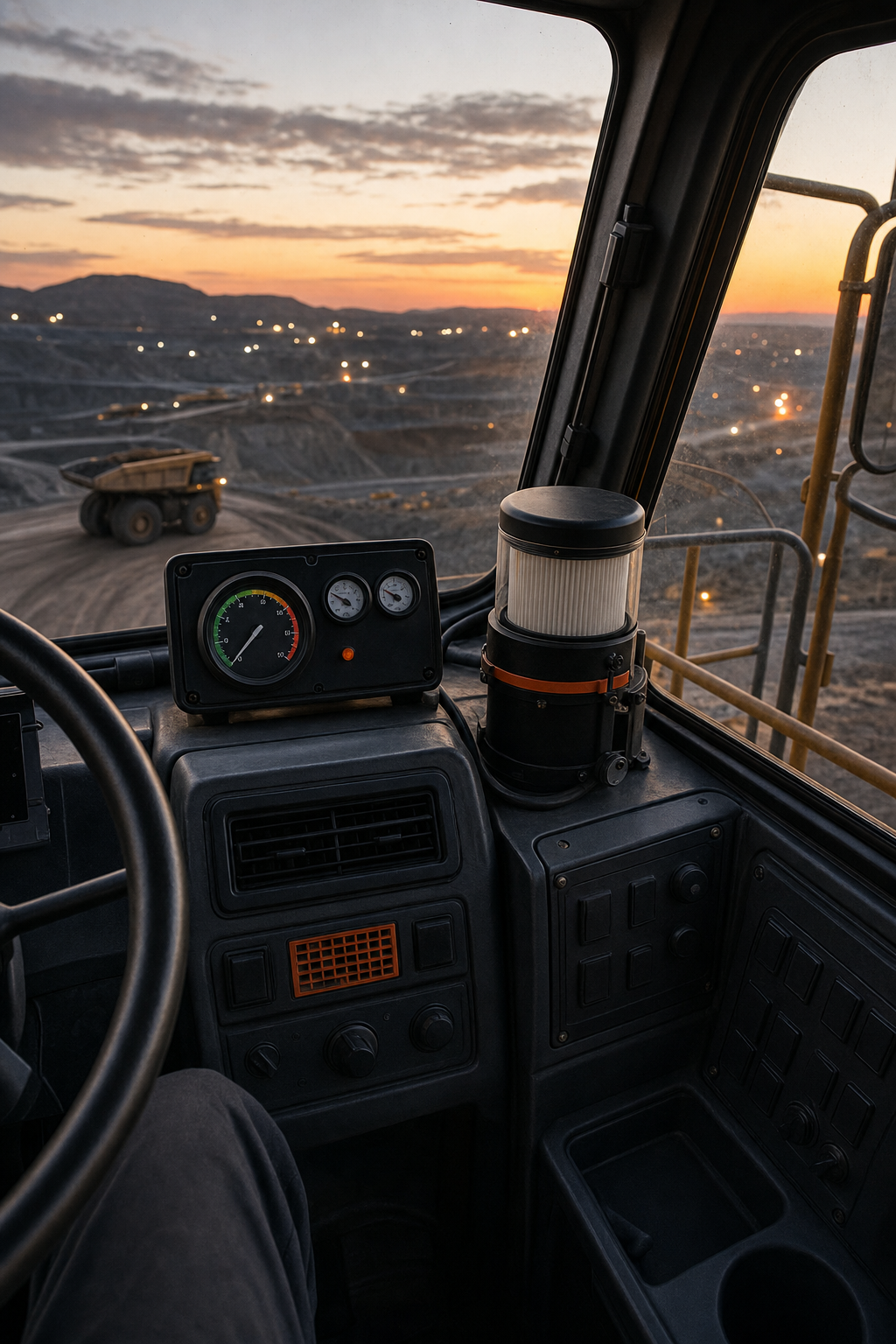
The standard structures compliance across four stages. First, the enclosure is engineered to hold pressure: sealed at every ingress point, with fresh-air intake ducted away from engine exhaust, and fitted with a precleaner or prefilter before the primary HEPA-grade filter. Second, the system is tested on the machine using four defined performance tests, and results are captured in a formal test report. Third, the cab is monitored in service through continuous pressure and CO₂ monitoring with visible green/amber/red displays the operator can read from the seat. Fourth, performance is maintained and documented through a servicing schedule, filter change records, and a supplier’s declaration of conformity per ISO/IEC 17050-1.
One point that catches operations off guard: a cabin that passes its initial test does not stay compliant on its own. Filters load with dust, seals compress and harden, and pressure drifts. The standard anticipates this by requiring ongoing maintenance records and recommending annual re-testing. The declaration of conformity and the maintenance instructions are normative requirements, not suggestions.
ISO 23875 was developed for mining, but the standard applies to any enclosed operator cab in fixed or mobile equipment. Drilling, loading, hauling, and crushing operations all generate the respirable dust and diesel particulate matter (DPM) that the standard is designed to control. Understanding our ISO 23875 cab air quality solutions starts with knowing exactly which performance thresholds your systems must hit.
How ISO 23875 Relates to MSHA Regulations and OHS Obligations
ISO 23875 sits alongside, not above, national regulatory frameworks. In the United States, the Mine Safety and Health Administration (MSHA) enforces exposure limits for respirable coal dust, silica, and diesel particulate matter in underground and surface mines under 30 CFR Parts 70 and 71. In Canada, provincial OHS legislation sets similar occupational exposure limits (OELs) enforced by workplace health and safety regulators. ISO 23875 does not replace these rules. What it does is give engineers and fleet managers a tested, documented engineering control that can demonstrate due diligence toward meeting them.
Think of it this way. MSHA sets the exposure outcome you must prevent. ISO 23875 is the engineering methodology that proves your cab is actively working to prevent it. If a regulator or an internal OHS audit asks how you control operator exposure to crystalline silica dust or DPM inside the cab, a documented ISO 23875-compliant system gives you a defensible, internationally recognized answer. Without it, you are relying on informal controls that may not hold up under scrutiny.
For Canadian operations, ISO 23875 is increasingly referenced in OHS compliance frameworks and industry safety standards for mining and heavy construction. OHS officers responsible for managing contractor and operator safety programs treat ISO 23875 documentation, specifically the test report, maintenance records, and declaration of conformity, as concrete evidence that engineering controls are in place and maintained. That paper trail matters when an incident triggers a regulatory review.
There is also a liability dimension. Companies that cannot demonstrate active engineering controls for cab air quality face greater exposure in the event of an occupational illness claim. Silica-related disease and diesel exhaust exposure are well-documented health risks, and the burden of proof increasingly falls on the employer to show that adequate controls were in place. A maintained, re-tested, documented ISO 23875 system is one of the strongest forms of that proof available to fleet operators right now.
OHS managers integrating this standard into their programs should treat it as part of a broader hierarchy of controls, not a standalone fix. Cab filtration and pressurization address exposure at the operator level. Site-level controls, wet suppression, road dust management, and equipment sequencing all reduce the ambient concentrations the cab system has to handle. The cab system is the last line of defence. It should not be the only one.
Key Engineering Requirements: Filtration, Pressurization, and HVAC Performance
Getting a cab to meet ISO 23875 is an engineering problem with several interdependent parts. Changing one affects the others. A high-efficiency HEPA filter that loads quickly under heavy dust will drop airflow, reduce cab pressure, and push the system out of its 20 Pa floor faster than expected. The engineering has to be designed as a system, not as a collection of individual components bolted together.
Filtration: Grades and Configurations
The standard calls for both an external-air filter and a recirculation filter. For most mining applications, that means HEPA-grade media. ISO 23875 references ISO 15 E and ISO 35 H filter classifications, and in practice, H13 HEPA filters that capture ≥99.97% of particles at 0.3 microns are the configuration that meets the particulate decay requirements. A precleaner or prefilter upstream of the primary filter is not optional in high-dust environments. Without it, the primary filter loads in hours instead of days, and maintenance intervals become operationally unworkable.
Cyclonic precleaners are the common choice for heavy mining and earthmoving equipment. They use centrifugal force to spin out large and medium particles before they reach the filter media. This extends filter life considerably and keeps system airflow stable across longer maintenance cycles. The precleaner discharges to the outside of the cab, so its ejection port placement matters for re-ingestion risk.
Pressurization: Holding the Floor
Positive cab pressure is what keeps contaminated air out. The 20 Pa floor in ISO 23875 is the minimum sustained pressure the system must hold. But pressure is not just a fan speed setting. It depends on the integrity of the entire enclosure: door seals, window gaskets, cable penetrations, panel welds, and any duct connections that pass through the cab wall. A 10 mm gap in a door seal can bleed pressure faster than the blower unit can compensate in high-wind or high-dust conditions.
The continuous pressure monitor required by the standard is not just a compliance checkbox. It is the instrument that tells you when the system is fighting a losing battle. A pressure reading trending toward the 20 Pa floor during a shift means something has changed: a door seal is failing, a filter is overloaded, or a duct connection has loosened. Operators trained to watch that monitor can catch problems before they become exposures.
HVAC Integration
The cab air quality system does not operate in isolation from the HVAC system. In most heavy equipment, the HVAC system handles temperature control using the same air handling infrastructure that the filtration and pressurization system depends on. Our heavy-duty air filtration units and systems are engineered to integrate directly with mobile HVAC infrastructure, including hydraulic-driven systems, so pressurization performance does not degrade when the operator switches between heating and cooling modes.
Compliance Challenges in Extreme Environments: Heat, Cold, and Dust
Meeting ISO 23875 in a controlled lab environment is one thing. Sustaining it in a Canadian oil sands operation at -40°C, or in a hard-rock mine in a region where ambient temperatures push past 45°C, is a different challenge entirely. Temperature extremes affect every component in the system.
Cold Climate Challenges
In sub-zero conditions, filter media can become brittle. Rubber door seals harden and lose their compression set, creating gaps that bleed cab pressure. Condensation inside the HVAC ducting can freeze and block airflow channels. Hydraulic-driven HVAC systems have an advantage here because the hydraulic circuit generates heat independently of engine-specific heating capacity, but the air quality system still needs to maintain airflow through filter media that may be moisture-laden and partially frozen at startup.
Cold-start performance matters. A cab that drops below 20 Pa for the first 20 minutes of a shift while the HVAC system warms up is still an exposure event. Engineering solutions for cold climates include pre-heated filter housings, cold-rated seal materials, and airflow management systems that balance heating load against pressurization demand during warm-up sequences.
Hot Climate and High-Dust Challenges
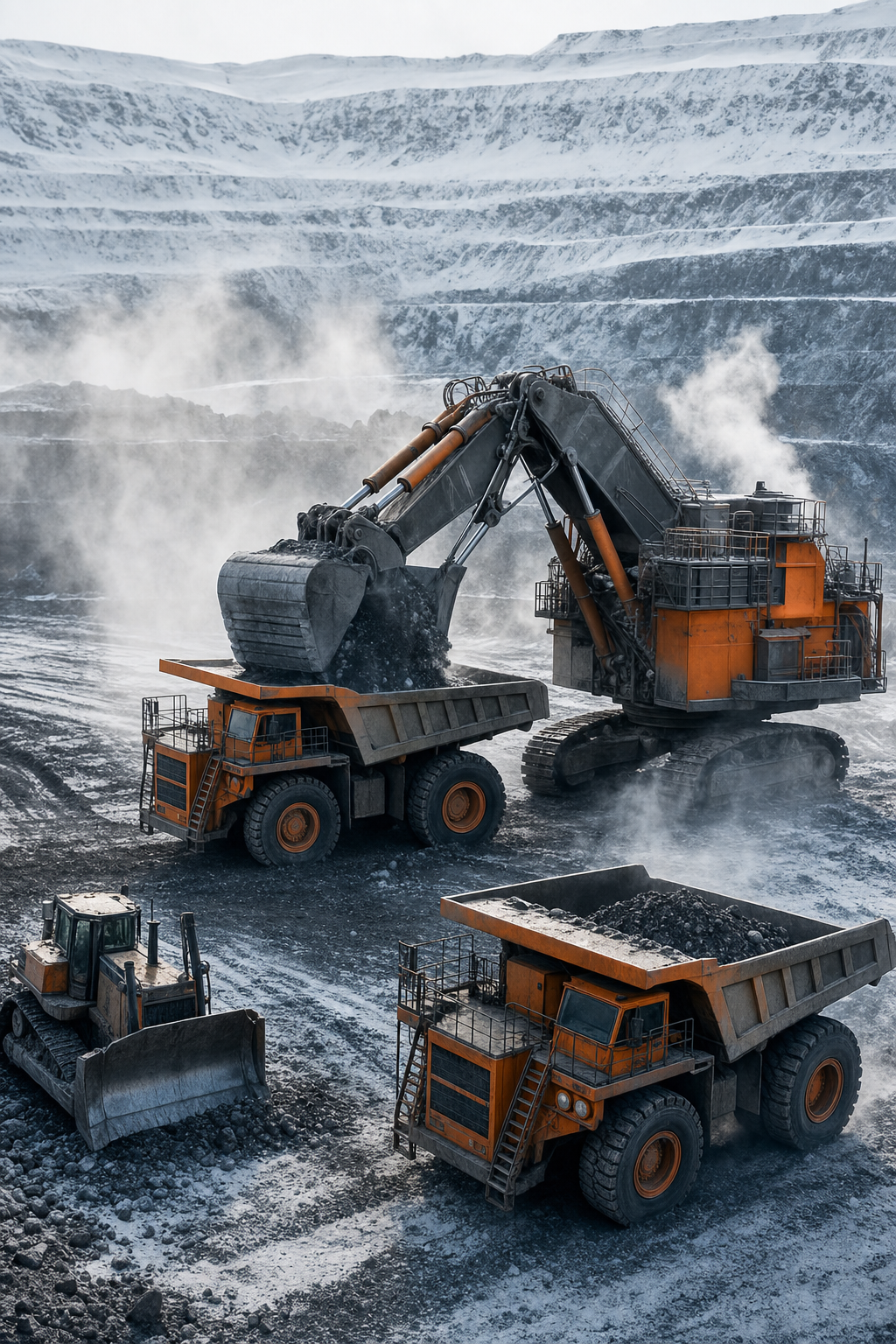
Heat increases filter loading rates because dry, fine dust becomes more airborne at higher temperatures. In operations running multiple machines in close proximity, a haul truck pulling into a loading bay can face ambient particulate concentrations that overwhelm a standard precleaner in a single shift. Improved temperatures also degrade filter media faster, reducing the effective filter life between maintenance intervals.
HVAC cooling capacity competes directly with pressurization in hot conditions. When the operator cranks the cooling system to maximum, the increased air recirculation can reduce the proportion of fresh filtered air entering the cab. Systems designed for hot-climate compliance need explicit recirculation filter staging so that the recirculated air loop is also filtered to the HEPA grade required by the standard.
Dust Variety Matters
Respirable crystalline silica from hard-rock cutting has different particle size distribution than coal dust or hydraulic fluid aerosol from equipment wear. A filter specification that handles one dust type well may perform differently with another. Pre-selecting filter media based on the specific dust environment, rather than a generic HEPA classification, is part of the design work that separates a system that holds its performance target across a full maintenance interval from one that degrades mid-cycle.
How Polar Mobility Research Ltd. Delivers ISO 23875 Compliance Solutions
We have been building custom heating, cooling, and air filtration systems for heavy-duty industries in extreme conditions for years. ISO 23875 compliance is not a product line we added to a catalogue. It is the engineering framework we work within on every cab air quality project, whether it is a new machine build or a retrofit on aging fleet equipment.
Our approach starts with the machine. We look at the specific equipment type, the operating environment, the duty cycle, and the dust profile before we specify anything. A surface mining haul truck running 12-hour shifts in a high-silica quarry has different system requirements than an underground development drill with limited airflow headroom in the cab. We do not spec the same solution for both.
New Builds and Retrofits
For new builds, we integrate sealed enclosure design, HEPA filtration, hydraulic or electric pressurizer units, and real-time pressure and CO₂ monitoring from the ground up. The system is commissioned and tested to the ISO 23875 Clause 5 performance tests before the machine goes to site. The customer receives a complete test report and a declaration of conformity.
For retrofit projects, we assess the existing cab’s sealing integrity first. There is no point installing a high-performance pressurizer on an enclosure that leaks through a dozen worn door seals and cable grommets. We identify the seal failures, remediate the enclosure, then install the filtration and pressurization system. Existing equipment can be upgraded with Sy-Klone RESPA systems, HEPA filters, and monitoring devices to achieve compliance. Our ISO 23875 air quality standard solutions cover both new installation and retrofit pathways, so operators don’t need to replace equipment to achieve compliance.
Filtration Technology
We use Sy-Klone RESPA systems as a core filtration platform. The RESPA-CF2, for example, integrates a powered precleaner, primary HEPA filter, and pressurizer in a single compact unit. The precleaner removes more than 90% of coarse dust before it reaches the filter media, which extends filter life significantly under high-dust loads. HEPA filter media in these units captures ≥99.97% of particles at 0.3 microns. The RadialSHIELD filter housings are built to handle the vibration and moisture typical of heavy mining and earthmoving equipment.
Monitoring and Documentation
We install the RESPA Advisor+ monitor, which provides continuous real-time pressure and CO₂ readings with the green/amber/red display and audible alarms the standard requires. Data logging capability allows maintenance teams and OHS officers to review historical pressure and CO₂ trends, which matters when you need to demonstrate ongoing compliance rather than a single point-in-time pass.
If you need it and it does not exist off the shelf, we build it. That is not a marketing line. It is how we handle non-standard cab configurations, unusual dust environments, and legacy equipment where commercial off-the-shelf kits do not fit. Our Canadian engineering team designs, tests, and manufactures custom configurations for exactly those situations.
Selecting an ISO 23875 Compliance Solution: What Fleet and OHS Managers Must Evaluate
Choosing the right ISO 23875 system is not a spec-sheet exercise. The system that looks best on paper may not hold its performance in your operating environment. Here is how to frame the evaluation.
| Evaluation Criterion | What to Ask | Why It Matters |
|---|---|---|
| Enclosure sealing assessment | Does the provider assess existing cab integrity before specifying a system? | A pressurizer cannot compensate for a leaking enclosure |
| Filter grade and precleaner | Is a HEPA-grade filter specified? Is a precleaner included for your dust environment? | Filter grade determines decay test performance; precleaner determines how long it holds |
| Pressure floor under load | What is the maintained pressure at 80% filter loading? | Most systems meet 20 Pa clean; the question is whether they hold it mid-interval |
| CO₂ and pressure monitoring | Is continuous monitoring with data logging included? | Required by the standard; also gives maintenance teams trend data |
| Test report and conformity declaration | Will you receive a Clause 5 performance test report and ISO/IEC 17050-1 declaration? | These are normative requirements — without them, you don’t have a compliant system |
| Retrofit vs. new build capability | Can the provider handle your existing fleet, not just new equipment? | Most fleets have aging machines that need retrofit solutions |
| Extreme environment ratings | Is the system rated for your operating temperature range? | Cold-climate seal failure and heat-related filter degradation are real failure modes |
| Maintenance interval practicality | What is the realistic filter change interval at your actual dust concentration? | Theoretical intervals set in clean conditions are often unachievable at site |
When evaluating providers, ask specifically about what happens when ambient dust concentrations spike beyond the system’s design conditions. A precleaner that handles typical haul road dust may not keep up with a blasting event followed by immediate re-entry into the active zone. The system’s response under peak load, not average load, is the real test of whether it holds the pressure floor and keeps CO₂ in range.
Documentation is not an afterthought. Fleet maintenance managers who have gone through an OHS audit or an MSHA inspection know that a binder of filter change records and a dated test report carry more weight than a marketing sheet. Whichever provider you work with, confirm before any purchase that they will deliver a complete Clause 5 test report, a declaration of conformity, and a maintenance schedule with defined inspection intervals.
Evaluating technology partnerships in complex technical environments often comes down to whether the partner can support you when conditions change. A useful framework for thinking about long-term technical partnerships, including assessing whether a provider builds for durability or just for the initial sale, is outlined in this guide to choosing a development partner that lasts, the evaluation criteria translate well to any engineered system deployment.
Frequently Asked Questions
What is the difference between ISO 23875 and a basic cab pressurization system?
A basic pressurization system maintains positive pressure but is not independently tested or documented to a defined performance standard. ISO 23875 specifies the exact pressure range (20, 200 Pa), particulate decay limits, CO₂ thresholds, continuous monitoring requirements, and documentation obligations. A cab with a pressurizer but no formal test report and no continuous CO₂ monitor does not meet the standard, even if it physically maintains positive pressure most of the time.
Can existing heavy equipment be retrofitted to meet ISO 23875?
Yes. Retrofitting is the most common path for established fleets. The process starts with a cab integrity assessment to find and remediate seal failures, then moves to installing the appropriate filtration, pressurizer, and monitoring equipment. The retrofitted system is then tested to ISO 23875 Clause 5 requirements, and a conformity declaration is issued. Polar Mobility Research Ltd. handles both the engineering assessment and the full system installation for retrofit projects.
How often does an ISO 23875 compliant system need to be re-tested?
The standard recommends annual re-testing through Annex B, which is informative, not normative. However, the maintenance instructions and ongoing documentation requirements in Clauses 5 and 6 are normative. In practice, most OHS programs and mining site safety requirements treat annual re-testing as an obligation. Any modification to the cab structure or the air quality system also triggers re-testing before the machine returns to service.
What filter grade does ISO 23875 require?
ISO 23875 references ISO 15 E and ISO 35 H classifications. In practice, H13 HEPA filters that capture ≥99.97% of 0.3-micron particles are the configuration needed to meet the particulate decay test requirements. Both an external-air filter and a recirculation filter are required. A precleaner upstream of the primary filter is not mandated by the standard but is functionally essential in any high-dust operating environment to maintain filter life within usable maintenance intervals.
Does ISO 23875 compliance satisfy MSHA regulatory requirements?
ISO 23875 is not an MSHA regulation, so it does not replace MSHA compliance obligations under 30 CFR. However, a documented ISO 23875-compliant cab air quality system is strong evidence of an engineering control for respirable dust and DPM exposure. It supports due diligence arguments in regulatory reviews and occupational illness proceedings. Consult a qualified industrial hygienist or OHS legal counsel to confirm how it interacts with your specific regulatory obligations.
What happens if cab pressure drops below 20 Pa during a shift?
The continuous pressure monitor required by ISO 23875 must alert the operator with an audible alarm and a red display indicator when pressure falls below the 20 Pa floor. At that point, the cab is no longer providing the designed protection against particulate ingress. The operator should stop work in the contaminated zone and report the issue for maintenance inspection. Common causes are a loaded filter, a failed door seal, or a pressurizer blower fault.
Conclusion
ISO 23875 is the clearest engineering benchmark the industry has for protecting operators from what they breathe inside the cab. Meeting it requires a designed system, a documented test, continuous monitoring, and a maintained record , not just a filter and a blower. If your fleet is not yet compliant, or if you are unsure whether your current setup actually meets the performance thresholds, reach out to Polar Mobility Research Ltd. We assess, specify, install, and certify cab air quality systems for heavy equipment operating in the conditions where this standard matters most.