
While many resources will name the compressor, condenser, and evaporator as critical components of an AC unit, all air conditioning parts play an important role in the cooling process. At Polar Mobility, we are a mobile equipment heating and cooling equipment supplier in Calgary that provides all components, big or small.
This article focuses on fans, blowers, and DC motors – keep reading to learn more about their functions and common issues to look for.
The role of fans in HVAC units
Many industries rely on fans to generate moving air and maintain a comfortable, well-ventilated work environment. The three most common types of fans include:
- Axial – Propeller-shaped blades that surround a rotating shaft and operate at higher speeds than other types of fans. In a mobile air conditioning system, axial fans are used for cooling or diluted ventilation purposes where there is no natural airflow.
- Forward-Curve Centrifugal – A wheel-shaped fan that draws air into the inlet of the blower housing. Forward-curve centrifugal fans are typically used for air-handling units that need to blow air into the ductwork.
- Backward-Inclined – As the name suggests, this type of fan is designed with a backward blade that handles a variety of air flows relative to static pressure. Backward-inclined fans are typically used for industrial applications where factors such as dust collection, glass tempering, incineration systems, and energy recovery ventilation exist.
Common issues that indicate a damaged or malfunctioning fan:
- The fan won’t start at all even when the AC is on
- The fan won’t stop when the AC is shut off
- Slow rotating blades
- A rattling noise when the fan is turned on
- The space is not cooling as quickly as it should
The role of blowers in HVAC units
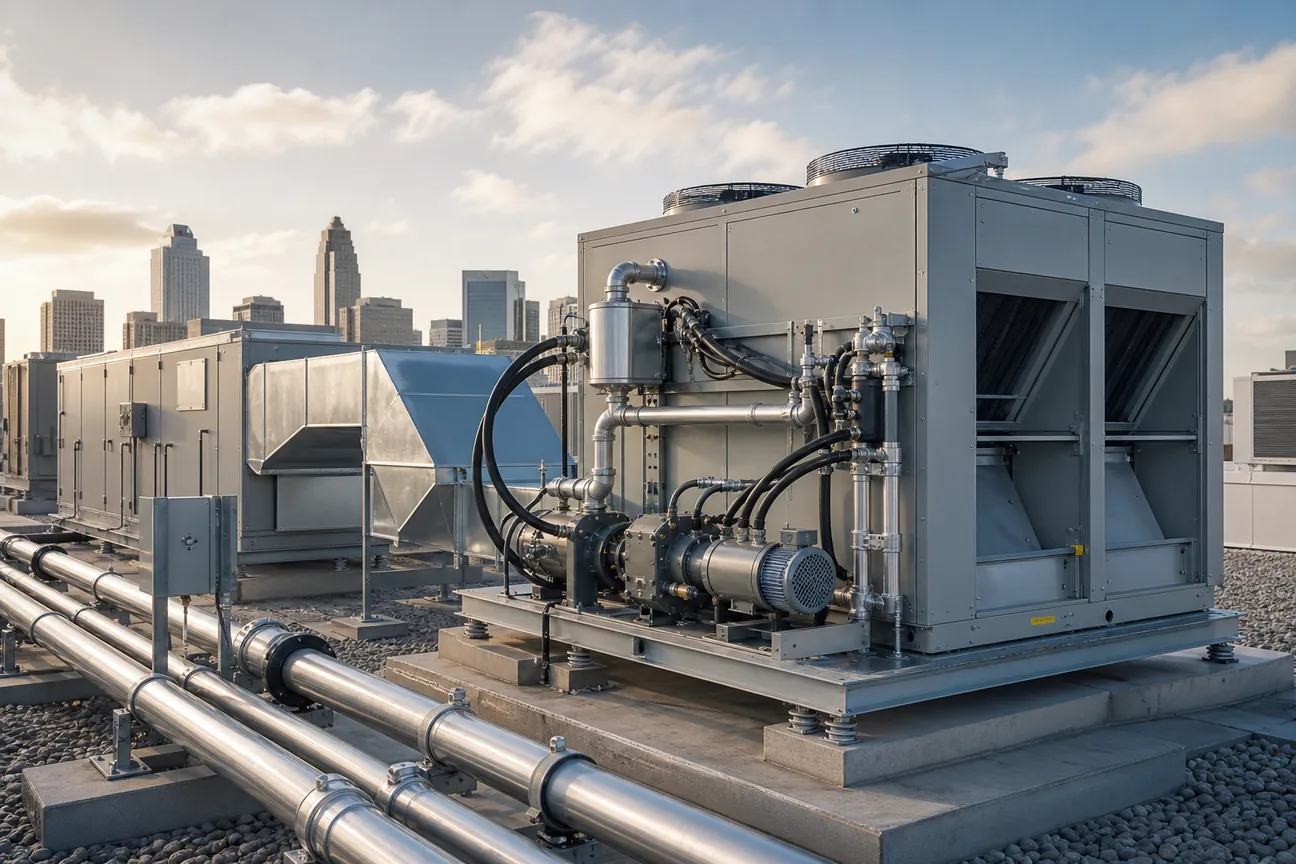
Simply put, the blower in an HVAC system blows the conditioned air through the vents. A blower motor spins the fan, causing air to move through the vents. A resistor on the blower motor controls the speed.
As the blower circulates the air, the specified temperature is reached and keeps the space comfortable. Without the blower, the airflow would be weak and won’t circulate properly through the space, causing the unit to overwork or lead to high energy consumption.
Common issues that indicate a damaged or malfunctioning blower:
- Weak airflow coming out of the vents
- No airflow at all
- Strange sounds
- High energy consumption
The role of a DC motor in HVAC units
A DC motor installed in the HVAC unit’s fan allows for quick equipment start and stop times, which is essential to avoid lengthy downtime. DC motors convert direct current (DC) electrical energy into mechanical energy. They are often used for heavy-duty off-highway equipment, trucks, automotive, and RV cooling and ventilation systems.
Common issues that indicate a damaged or malfunctioning DC motor:
- Start and stop times are taking longer than usual
- The DC motor is not running as efficiently as it should be
Where to find fans, blowers, and DC motors in Calgary
At Polar Mobility, we stock an inventory of fans, blowers, and DC motors for mobile equipment. We also supply air conditioning parts to keep your system running smoothly. If you can’t find what you’re looking for in our catalog, give us a call and we can help customize a solution for your specific worksite or equipment.