
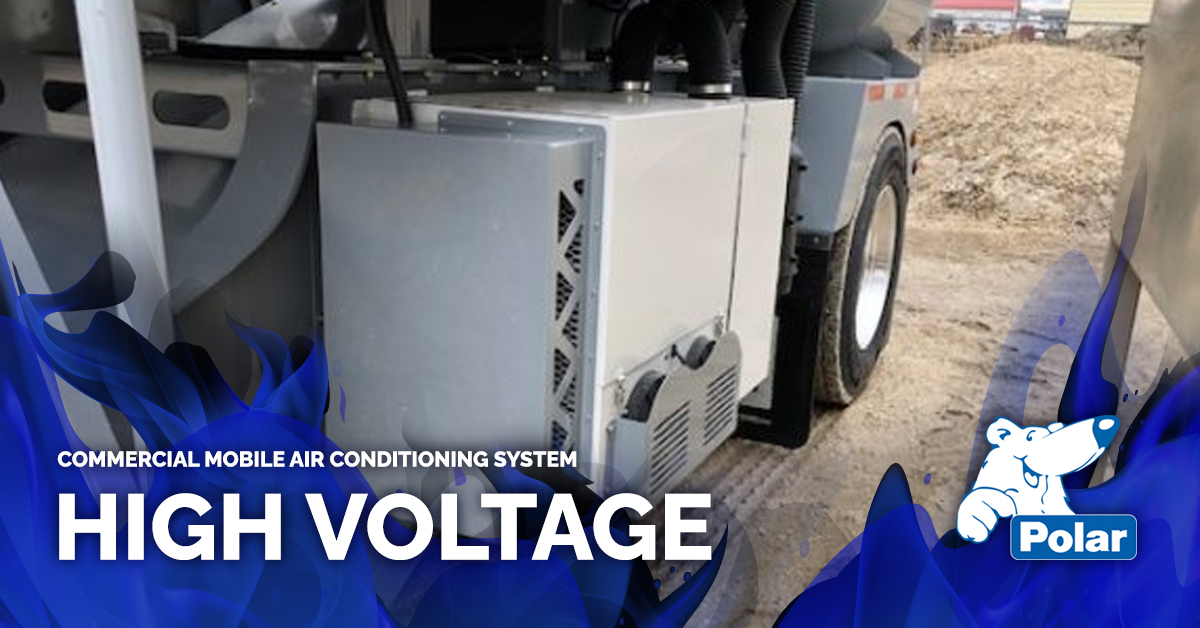
With hot weather just around the corner, a reliable mobile air conditioning system is at the top of the list for fleet managers and heavy-duty equipment operators. Before you buy any air conditioner, knowing how the electricity for a mobile AC unit works can help save you money in the long run and keep your operations running productively.
This article provides more information on high voltage air conditioning systems, their benefits, and the type of worksites and equipment they’re ideal for.
What is a high voltage air conditioning system?
Air conditioners are labeled with a voltage measurement which is referred to as the electrical potential between two points. Electrons are moved by voltage and the force of this movement is determined by how hard they are being pushed along the wire. Essentially, a high voltage system provides more efficient bulk power transfer across lengthy distances compared to a low voltage air conditioning system.
At Polar Mobility, we offer products that operate with high voltage direct current (HVDC). Our high voltage air conditioning systems can handle 50/60 Hz voltages and work with 2 & 3 phase alternating current (AC).
Commercial high voltage AC units are often used for control rooms, process equipment, overhead cranes, mining equipment, heavy-duty construction fleets, military fleets, and industrial work sites.
The benefits of a high voltage air conditioning system
High voltage systems use less energy and, with the smaller current, less energy is lost. High voltage air conditioning units help save businesses money and deliver efficient cooling. The benefits of these systems include:
- A unit that lasts longer and can handle higher capacities
- More efficient bulk power transfer across lengthy distances
- Reduced energy costs and better productivity
High voltage AC units are designed to withstand extreme conditions and handle high capacities, making them ideal for military, mining, and construction environments where temperatures can reach up to 55 degrees Celsius. The designing on these units is strong enough to withstand shock and vibration and is safe to use in hazardous atmospheres. Polar Mobility units provide a contaminant-free air-conditioned space and deliver high performance while increasing operator safety.
Finding the right air conditioning system
While a high voltage AC unit is energy-efficient and powerful, it’s not made for all applications or worksites. Utilizing a high-voltage system where it’s not needed can cause equipment breakdown and cost the business more money. Consider the range of power requirements for your application, including voltage, amperage, and wattage.
Browse our selection of high voltage air conditioning units to find the right product for your needs. We also carry an inventory of other HVAC units and systems, including 12-24 Vdc Drive and hydraulic systems. If you’re not sure about the type of mobile AC unit you need, give us a call and we can help you find the right solution.